AI Billing & Operations Portal
Explore customer billing, review an invoice, adjust pricing, and download a PDF. Switch to Usage Analytics to investigate the underlying requests.
AI Billing & Operations Portal
Cobalt Ridge Insurance
- Markup
- 18%
- Markup
- 18%
- Platform fee
- $400.00
- Last finalized invoice
- $907.16
- November 2026 to date
- $225.57
On provider cost · read-only
Per month · illustrative
August 2026
Estimated cost · through 15 Nov 2026
Invoices
Monthly, in USD · production usage only
| Period | Invoice | Status | Estimated cost | Provider cost | Markup | Platform fee | Amount billed | Actions |
|---|---|---|---|---|---|---|---|---|
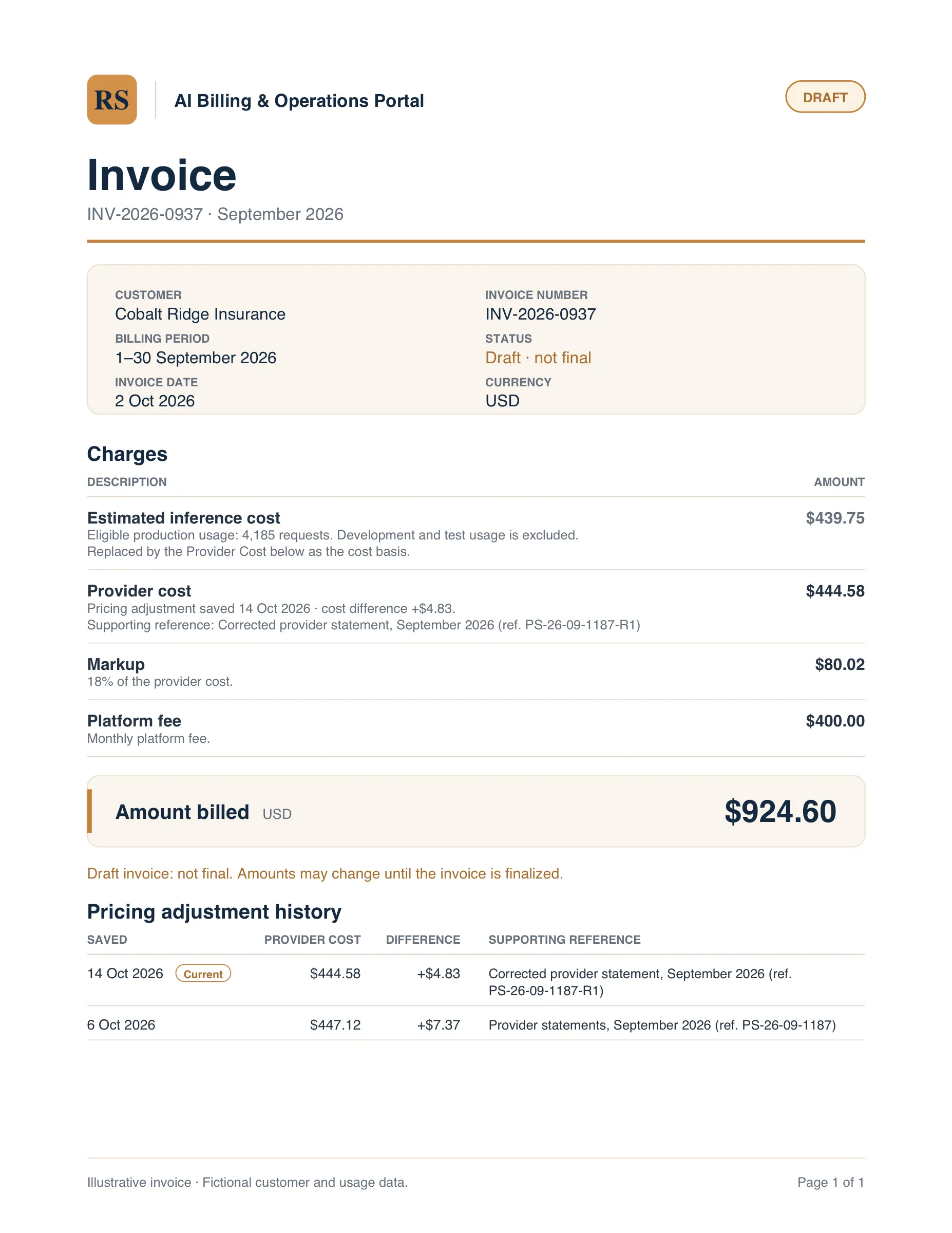
| October 2026 | Not generated | Ready to generate | — | — | — | — | — | |
| September 2026 | INV-2026-0937Generated 2 Oct 2026 | Draft | $439.75 | $444.58+$4.83 | $80.02 | $400.00 | $924.60 | |
| August 2026 | INV-2026-0841Finalized 9 Sep 2026 | Finalized | $424.11 | $429.80+$5.69 | $77.36 | $400.00 | $907.16 |
Amounts are calculated from eligible production usage; development and test usage is excluded. Provider cost appears when a pricing adjustment has been saved. Pricing is illustrative.
Pricing Adjustment History
| Invoice | Saved | Estimated cost | Provider cost | Cost difference | Supporting reference |
|---|---|---|---|---|---|
| INV-2026-0937CurrentSeptember 2026 | 14 Oct 2026 | $439.75 | $444.58 | +$4.83 | Corrected provider statement, September 2026 (ref. PS-26-09-1187-R1) |
| INV-2026-0937September 2026 | 6 Oct 2026 | $439.75 | $447.12 | +$7.37 | Provider statements, September 2026 (ref. PS-26-09-1187) |
| INV-2026-0841August 2026 | 8 Sep 2026 | $424.11 | $429.80 | +$5.69 | Provider statements, August 2026 (ref. PS-26-08-4471) |
- Requests
- 4,473
- Tokens
- 175.8M
- Estimated cost
- $474.35
- Pricing exceptions
- 0
40 failed (1%)
170.2M input · 5.6M output
Production $440.59 · Dev & test $33.75
Every request has a rate
By provider and model
Last 30 days · usage through 15 Nov 2026
| Provider | Model | Requests | Input tokens | Output tokens | Estimated cost | Share of cost |
|---|---|---|---|---|---|---|
| Anthropic | Claude Sonnet 4.5 | 1,517 | 103.2M | 3.2M | $295.61 | 62% |
| OpenAI | GPT-4o | 609 | 61.7M | 2.0M | $173.87 | 37% |
| Anthropic | Claude Haiku 4.5 | 936 | 4.2M | 390.7K | $4.84 | 1% |
| OpenAI | text-embedding-3-small | 1,411 | 1.1M | 0 | $0.02 | <1% |
| Total | 4,473 | 170.2M | 5.6M | $474.35 | ||
Usage events
One row per request, newest first · times in UTC
| Time (UTC) | Application | Model | Environment | Status | Duration | Cache | Tokens in / out | Estimated cost |
|---|---|---|---|---|---|---|---|---|
| 15 Nov 2026 23:38:07cob-20261115-0070 | Claims Intake Assistant | Claude Sonnet 4.5Anthropic · Messages API | Test | 200 OK | 48.6 s | — | 88,506 / 2,496 | $0.3030 |
| 15 Nov 2026 23:19:31cob-20261115-0069 | Claims Intake Assistant | Claude Sonnet 4.5Anthropic · Messages API | Test | 200 OK | 38.1 s | Hit | 23,242 / 1,908 | $0.0356 |
| 15 Nov 2026 23:15:16cob-20261115-0068 | Agent Desk Search | text-embedding-3-smallOpenAI · Embeddings API | Production | 200 OK | 165 ms | — | 576 / 0 | <$0.0001 |
| 15 Nov 2026 22:50:30cob-20261115-0067 | Claims Intake Assistant | Claude Sonnet 4.5Anthropic · Messages API | Production | 200 OK | 51.4 s | — | 54,424 / 2,306 | $0.1979 |
| 15 Nov 2026 22:50:12cob-20261115-0066 | Agent Desk Search | text-embedding-3-smallOpenAI · Embeddings API | Production | 200 OK | 174 ms | — | 1,131 / 0 | <$0.0001 |
| 15 Nov 2026 22:03:39cob-20261115-0065 | Policy Summaries | GPT-4oOpenAI · Batch API | Production | 200 OK | 94.3 s | — | 96,586 / 3,204 | $0.2735 |
| 15 Nov 2026 21:55:36cob-20261115-0064 | Agent Desk Search | Claude Haiku 4.5Anthropic · Messages API | Test | 200 OK | 3.4 s | — | 2,249 / 339 | $0.0039 |
| 15 Nov 2026 21:34:51cob-20261115-0063 | Agent Desk Search | Claude Haiku 4.5Anthropic · Messages API | Production | 200 OK | 1.8 s | Hit | 3,674 / 243 | $0.0016 |
| 15 Nov 2026 21:16:35cob-20261115-0062 | Agent Desk Search | Claude Haiku 4.5Anthropic · Messages API | Production | 200 OK | 2.7 s | — | 5,008 / 283 | $0.0064 |
| 15 Nov 2026 21:04:09cob-20261115-0061 | Claims Intake Assistant | Claude Sonnet 4.5Anthropic · Messages API | Production | 200 OK | 86.1 s | — | 53,021 / 3,172 | $0.2066 |
| 15 Nov 2026 20:54:50cob-20261115-0060 | Agent Desk Search | text-embedding-3-smallOpenAI · Embeddings API | Production | 200 OK | 166 ms | — | 727 / 0 | <$0.0001 |
| 15 Nov 2026 20:53:56cob-20261115-0059 | Agent Desk Search | text-embedding-3-smallOpenAI · Embeddings API | Production | 200 OK | 161 ms | — | 1,263 / 0 | <$0.0001 |
| 15 Nov 2026 20:45:26cob-20261115-0058 | Claims Intake Assistant | Claude Sonnet 4.5Anthropic · Messages API | Production | 200 OK | 24.9 s | — | 75,188 / 1,210 | $0.2437 |
| 15 Nov 2026 20:37:56cob-20261115-0057 | Agent Desk Search | text-embedding-3-smallOpenAI · Embeddings API | Production | 200 OK | 173 ms | — | 1,086 / 0 | <$0.0001 |
| 15 Nov 2026 20:30:09cob-20261115-0056 | Agent Desk Search | Claude Haiku 4.5Anthropic · Messages API | Production | 200 OK | 4.9 s | — | 3,505 / 604 | $0.0065 |
Showing 1–15 of 4,473 matching events · page 1 of 299