In Lesson 4.3, we instructed our Research Agent to load the Research Evidence Skill before evaluating a source.
But not every question needs that procedure. Can the agent decide when to load it?
From Required Loading to Selective Loading
Our previous agent was told to call load_research_skill() before source analysis. Now we’ll give it a more flexible instruction:
instructions=(
    "A Research Evidence Evaluation Skill is available through "
    "load_research_skill. Load it when source-quality assessment "
    "is relevant. For simple conceptual questions, answer directly. "
    "Do not call tools unnecessarily."
)
The agent can request the Skill when the task calls for evidence evaluation, rather than loading it for every interaction.
Two Questions, Two Paths
We’ll run two requests through the same agent.
A: Evidence assessment
Assess the credibility and limitations of curated research record
builder_pm_001as evidence for the Product Builder hypothesis.
This task benefits from the procedure in SKILL.md. The agent may load the Skill and retrieve the research record before answering.
B: Simple explanation
In one or two sentences, what is the difference between an MCP server and an MCP tool?
The agent can answer this conceptual question without retrieving a research record or loading the Skill.
Skill Selection and Progressive Disclosure
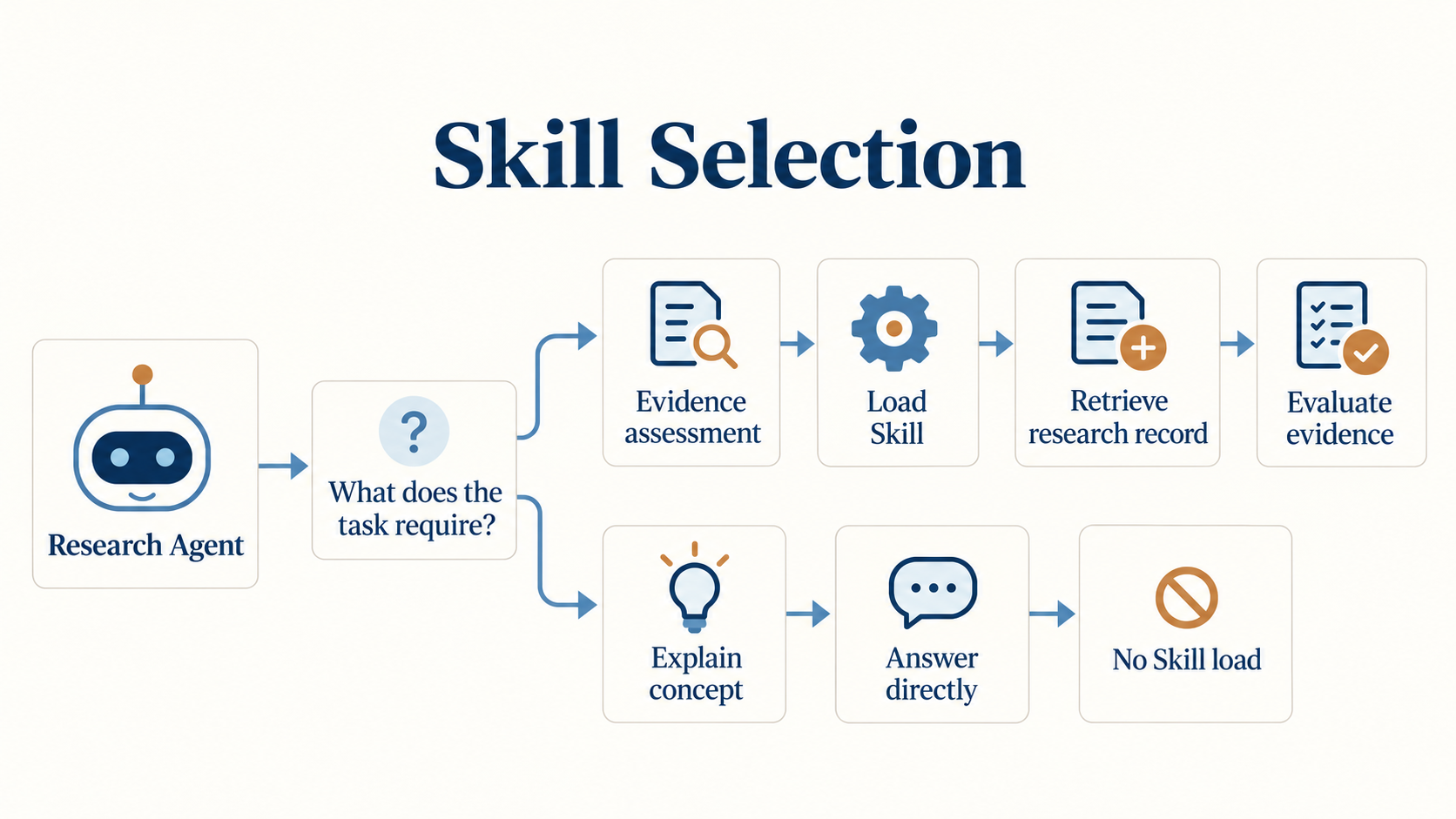
Progressive disclosure means making additional instructions available when they become relevant instead of placing every procedure into the agent’s initial context.
In our lab, the agent initially receives a short description of the available Skill. The full procedure is returned only if it calls load_research_skill().
This is a simplified example of on-demand instruction loading, not a native Skill registry or automatic Skill discovery system.
Run the Selection Experiment
Use the shared Lab 04: Agent Skills download. From the extracted lab-04 folder, with its virtual environment active, run:
python lab4_skill_selection.pyThe script asks both questions. For each run, it displays the final answer, the number of tool-call items, and each execution item: tool calls with their tool names and arguments, and a short preview of each tool result.
Inspect the output:
- For Question A, did the agent request the Skill? Did it also retrieve the research record?
- For Question B, did it avoid unnecessary tool calls?
- In the evidence assessment, did the response identify uncertainty and avoid treating illustrative metadata as verified research?
The model’s choices and exact tool-call counts can vary. A tool-call count alone does not prove that the Skill was followed correctly; inspect the result as well.
What This Experiment Teaches Us
Selective loading keeps specialized procedures separate until they are relevant. It also gives the agent discretion: it may make an unnecessary call, or fail to load a useful Skill.
For important workflows, we must evaluate both the agent’s tool choices and the quality of its conclusions. Some tasks may require stronger instructions or explicit execution controls.
What Did You Learn?
- An agent can be instructed to load specialized guidance only when a task calls for it.
- Progressive disclosure keeps full procedures out of the initial context until needed.
- Our implementation retrieves a Skill through a custom MCP tool.
- Tool-call traces show what the agent did, but the final answer still needs evaluation.
Test Your Understanding
Question 1 of 3
What does progressive disclosure mean in this lab?