
Module introduction
How Much Autonomy Should an AI Agent Have?
In Module 8, we built a research application that discovers sources, evaluates evidence, and produces findings. What changes when agents operate in an enterprise, where their actions can have security, financial, or business consequences?
Enterprise governance establishes boundaries for agent actions without removing the autonomy that makes agents useful.
Three Principles of Governed Agents
Agent Autonomy
Our Research Agent selects searches, evaluates evidence, and writes a research brief. It makes meaningful judgments, but those judgments may be incomplete or wrong.
Separation of Responsibilities
A Publication Review Agent independently assesses the brief. When it recommends publication, the application creates a governed request. Neither agent can authorize publication.
Enforceable Governance
The shared Governance Gateway controls permissions, operating budgets, validation, and approval requirements. It records decisions and outcomes. These controls live in application code, not in agent instructions.
Architecture: The Governed Research System
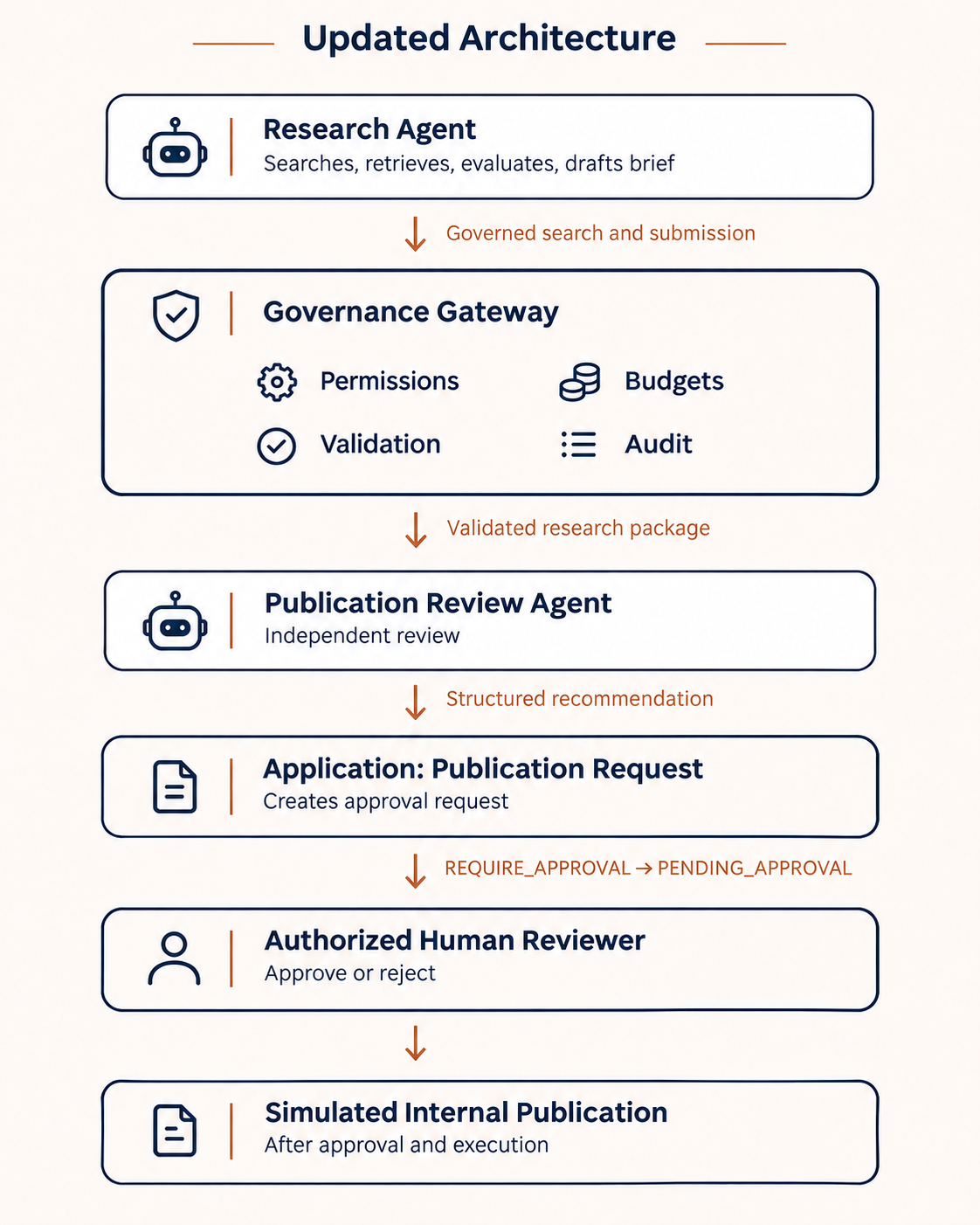
Both agents use the same gateway but have different permissions. Publication requires authorization from a human reviewer, even after an agent recommends it.
What You’ll Learn
- Distinguish an agent’s judgment from its authority to act.
- Understand tool permissions, budgets, and application-enforced boundaries.
- Trace an agent recommendation through a governed request and human approval.
- Inspect audit records, execution status, and recovery after a failure.
Lab 9: Governed Research and Publication
Investigate how AI is changing the Product Manager role. In Live Mode, a Research Agent searches real sources and develops an evidence-backed brief; a separate agent reviews its suitability for publication. The application enforces tool and approval policies, and publication is simulated locally.
Offline Mode lets learners explore the governance flow without model or search API calls.
Under the Hood: How We Built the Governed Research System
- Preserve a real agent session. Save a live review example so learners can inspect the recorded decision and replay governed requests without repeating the model call.
- Organize research artifacts. Keep evidence, claims, reports, evaluation results, and provenance together in a verifiable research package.
- Reuse completed work. Resume publication review from a saved, accepted research package without repeating searches or evidence retrieval.
- Extend the Governance Gateway. Define separate agent permissions, typed tool arguments, per-tool budgets, and session limits enforced outside the models.
- Govern search and retrieval. Route tool calls through the gateway, bind fetches to issued source IDs, validate destinations, and keep evidence text out of the audit log.
- Validate brief submissions. Check quotation matches, source references, structured claims, and Markdown consistency. Passing checks establish consistency, not research truth.
- Introduce the Research Agent. Let model reasoning select searches, evaluate evidence using the research Skill, and write a brief rather than using hard-coded findings.
- Separate publication review. A second agent recommends whether to publish. The application converts an affirmative recommendation into a governed request requiring human authorization.
- Support offline operation and recovery. Offer prepared inputs and recordings, require consent for live calls, and resume a failed review without repeating completed research.
- Inspect end-to-end execution. Follow research, review, approval, and simulated publication. Compare the agent’s original recommendation with the current application execution status.