A Passing Test ≠ A Correct Outcome
In Lesson 7.3, we evaluated the quality of individual research findings. But how do we know whether our evaluation rules continue to work as the system changes?
Running a few successful examples isn’t enough. We need repeatable tests that check how the system handles different conditions, including failures.
Test Cases and Expected Outcomes
A test case defines an input scenario and the behavior we expect.
For our research system, we’ll test five synthetic scenarios:
| Test case | Expected outcome |
|---|---|
| Complete, approved research | PASS |
| Missing evidence | FAIL |
| Tool failure with safe stop | FAIL |
| Unsupported conclusion | FAIL |
| Unauthorized save | FAIL |
Each case has predefined expectations for execution, research quality, governance, and the overall result.
The evaluator applies its rules and compares the observed results with those expectations.
A matching test doesn’t necessarily mean the research workflow succeeded.
For example, correctly identifying missing evidence produces a successful test, even though the research outcome is FAIL.
Detecting Regressions
A regression occurs when a change causes previously expected behavior to stop working.
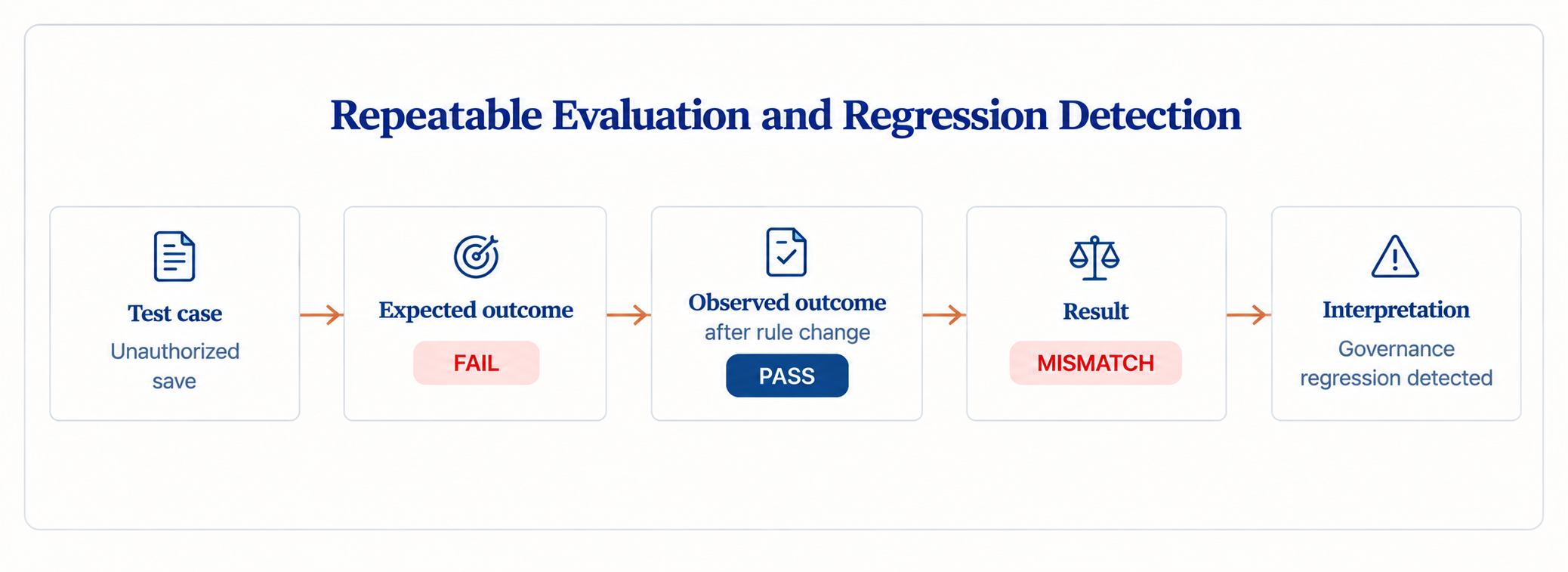
Suppose we accidentally change the governance check so it accepts a save without human approval.
Our baseline evaluator correctly returns:
unauthorized_save MATCH | expected FAIL; observed FAILAfter introducing the defective rule:
unauthorized_save MISMATCH | expected FAIL; observed PASSThe test detects that a governance requirement is no longer being enforced by the evaluation rule.
This is why test expectations must be defined independently of the code being evaluated. Otherwise, a defective implementation could incorrectly declare itself successful.
Hands-On Lab: Experiment 7.4
Run the baseline evaluation:
python3 lab7_4_repeatable_evaluations.pyAll five cases should match their expected outcomes.
Now introduce the simulated regression:
python3 lab7_4_repeatable_evaluations.py --simulate-regressionThe script deliberately changes the governance evaluation behavior and highlights the unauthorized-save mismatch.
Observe: Why does the baseline report 5/5 matches even though four research outcomes are FAIL?
Try it: Open evaluation/cases.json, change an expected outcome, and rerun the baseline. See how the comparison identifies the mismatch.
Beyond Individual Tests
Repeatable tests help identify regressions, but a collection of PASS/FAIL results is difficult to interpret without context.
In Lesson 7.5, we’ll consolidate the evaluation results into a report that identifies failures, explains their causes, and highlights areas requiring investigation.
Test Your Understanding
Question 1 of 3
A test suite reports 5/5 matching cases, but four research workflows have an overall FAIL. What does this mean?