From Research to Controlled Execution
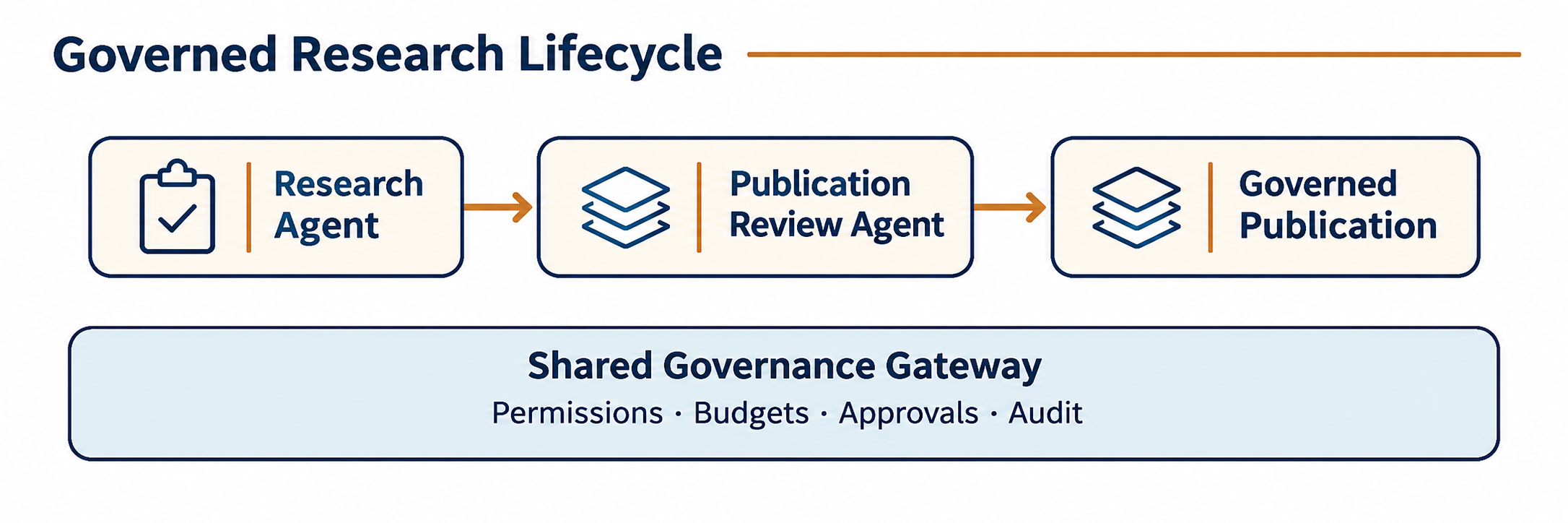
Our application brings together two independent agents and a shared Governance Gateway. The Research Agent finds and evaluates evidence, then writes a brief. The Publication Review Agent assesses the brief and recommends whether it is suitable for publication.
If publication is recommended, the application creates a request. The Governance Gateway applies policy, requires authorized human approval, and records the execution outcome. It also governs tool use during research and review, not just publication.
Agents make judgments. The application controls what can execute.
What One Live Run Showed
This example comes from one live run during course development. Live research results can vary, so your run may retrieve different sources or reach a different recommendation. The offline workflow demonstrates the same governance path using prepared, fictional material rather than live model reasoning.
The Research Agent investigated how AI is changing Product Manager roles and submitted a validated research brief. The available evidence was limited: some sources could not be retrieved, and the sample did not justify broad conclusions.
The independent Publication Review Agent recommended publication only as a qualified, exploratory internal brief. The application submitted a governed request. An unauthorized reviewer attempt was refused; an authorized reviewer subsequently approved it, and the report was published to a simulated local destination.
Passing structural checks did not prove the research was conclusive, and an agent recommendation did not authorize publication.
Lab 9.5: Connect the Complete Workflow
You do not need another paid live run. Reuse your session from Lessons 9.3 and 9.4, or create a new offline session from the extracted lab-09 folder:
python -m lab9.runSelect option 1, the offline research workflow. This uses prepared material without model API costs. Option 2 runs live AI research and review, requires the packages in requirements.txt (installed in the lab’s virtual environment), an API key and explicit consent, and may incur costs. The live outcome can vary with the retrieved evidence.
Inspect the saved research brief, the publication recommendation, the request status, and audit.jsonl. Explain:
- Which judgments were made by agents (or represented by prepared material in Offline Mode)?
- Which actions were enforced by the Gateway and which required human authorization?
- What evidence shows whether publication actually executed?
The aim is to connect the components and records, not to repeat the approval exercise.
Attention, Product Managers
Beyond the Lab: Owning Agent Quality
Shipping an agent is not the end of the product lifecycle. An agent can stay within its budget and pass every governance check while producing weak or misleading results. Quality must be reviewed after deployment, especially as information, usage, and requirements change.
The Agent Quality Improvement Loop
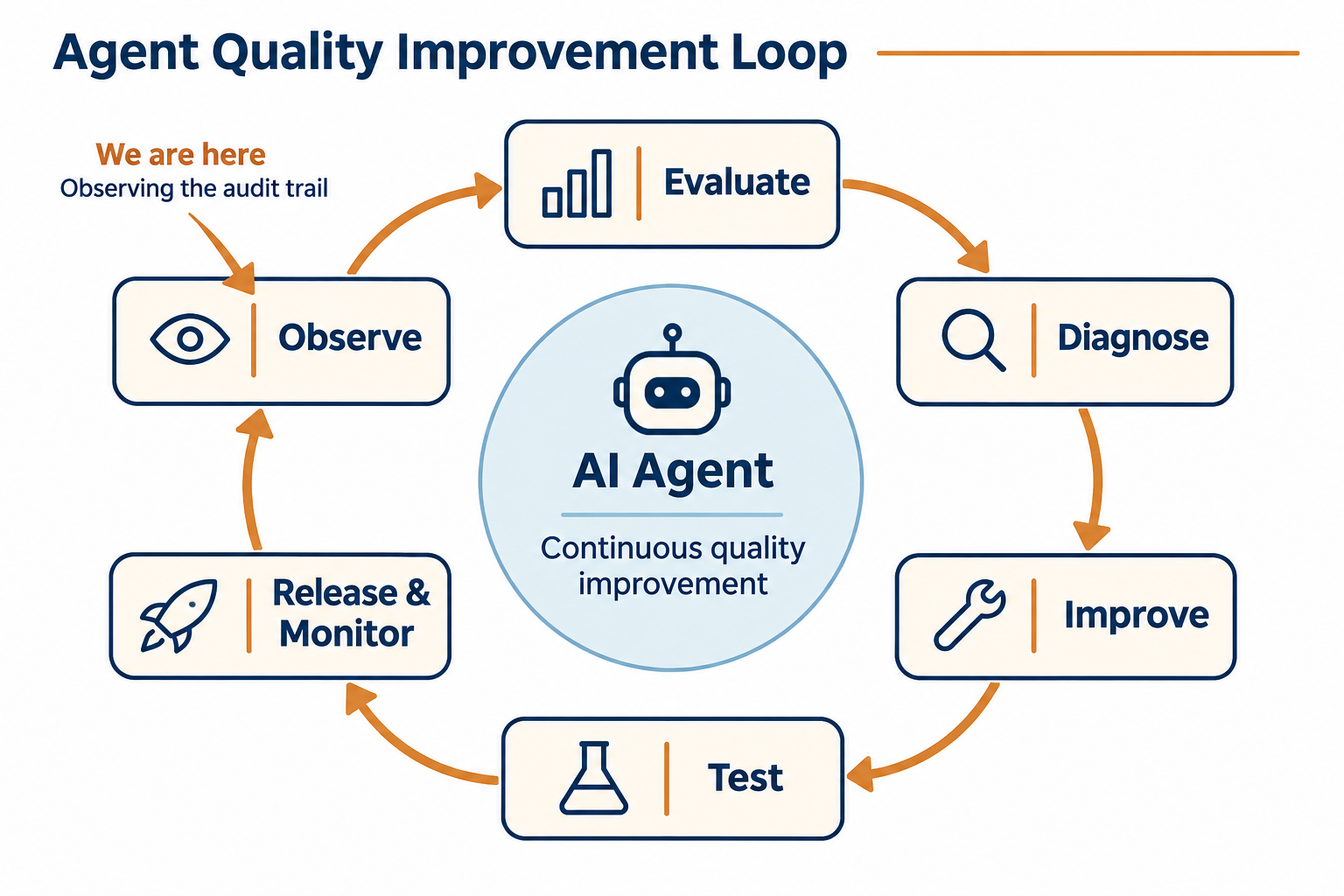
Observe → Evaluate → Diagnose → Improve → Test → Release and monitor
Collect representative outputs, user feedback, and traces. Assess them against agreed quality criteria. Investigate whether a problem comes from prompts, retrieved context, tools, models, or orchestration. Make a targeted change, add meaningful failures to the evaluation set, test for regressions, and monitor the released version.
For example, reviewers may find that our Research Agent repeatedly draws broad conclusions from a small number of job postings. The team examines examples and traces, identifies whether instructions or source selection caused the problem, and tests a correction before release. This is more reliable than changing a prompt based on a single disappointing answer.
Who Owns the Review Process?
| Role | Primary responsibility |
|---|---|
| AI / Agent Engineering Team | Operate quality monitoring, evaluations, investigations, and technical improvements. |
| Subject Matter Experts | Define and assess domain quality and review representative outputs. |
| Product Manager | Set product quality expectations and user outcomes; prioritize improvements with the team. |
Responsibilities may overlap in smaller teams, but ownership and a recurring review process should be explicit. The optional Appendix 1: Agent: Continuous Improvement explores practical review routines and emerging tracing conventions.
What We Learned
A useful enterprise agent needs autonomy for reasoning, enforceable boundaries for action, and evidence of what actually happened. After launch, it also needs an owned, repeatable quality improvement process.
Test Your Understanding
Question 1 of 3
What best describes the Governance Gateway's role in our research application?