From a Working Agent to a Product Decision
Imagine a small product team wants to use our PM Role Trends Research Agent regularly. Should we continue developing it, use managed services, or consider a ready-made agent?
Before comparing technologies, it helps to understand what the agent needs to accomplish.
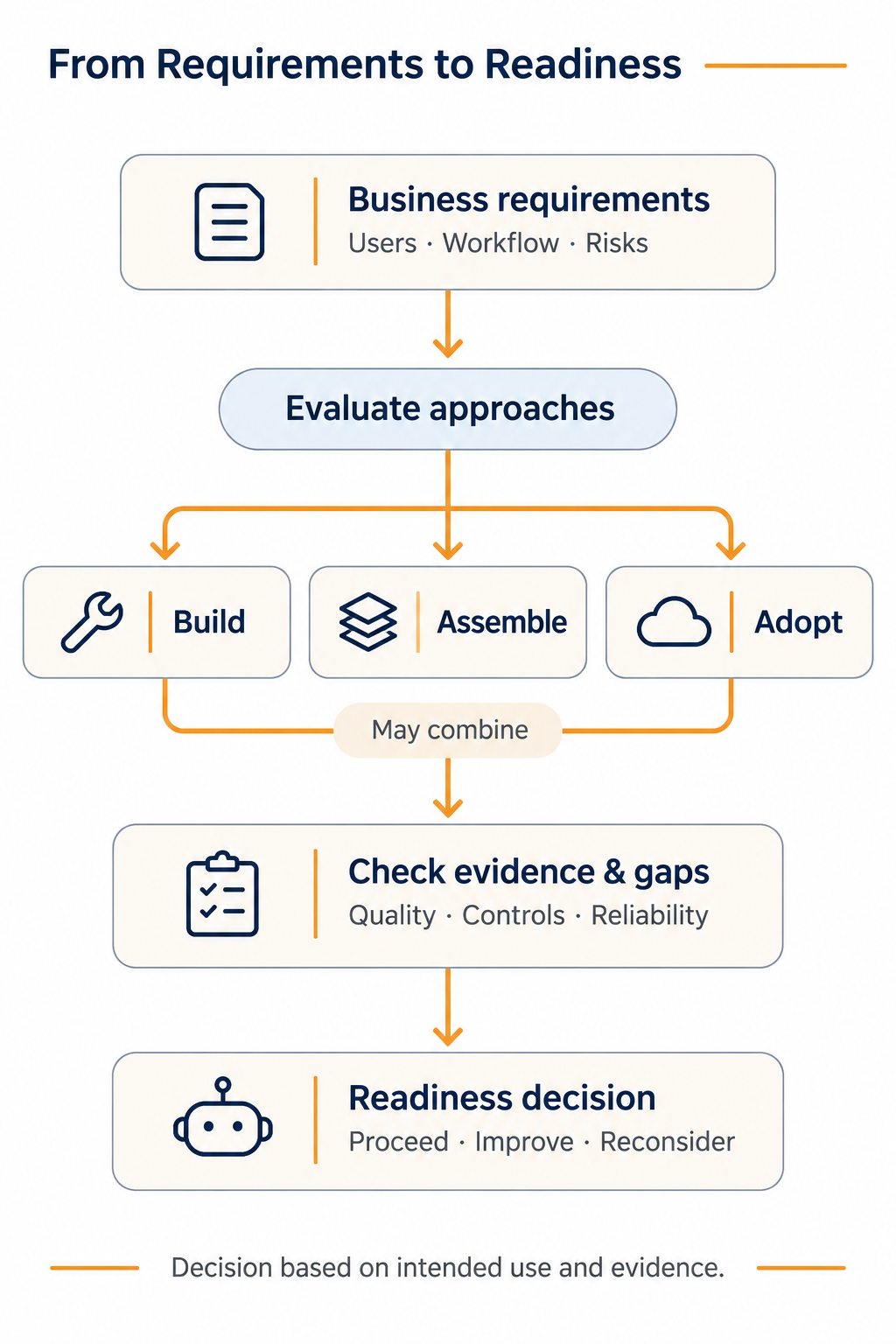
Start with the Business Need
Consider who will use the agent, which systems it must access, how its results will be used, and what could go wrong.
For example, preparing a research brief for a PM to review is different from automatically publishing conclusions across an organization. The latter requires stronger safeguards and clearer authority.
Build, Assemble, or Adopt
We introduced these approaches earlier. Here we compare them against the needs of a specific application.
| Approach | When it may fit | What to verify |
|---|---|---|
| Build with an SDK or framework | Specialized research or approval workflows | Engineering capacity and maintenance |
| Assemble using managed services | Custom logic with less infrastructure work | Integrations, operating capabilities, cost, and control |
| Adopt a ready-made agent | Existing features suit the required workflow | Configuration, evidence quality, and permissions |
Teams can combine approaches. For example, we might keep our governed research workflow while using managed storage and execution.
A platform may offer the features we need, but we should verify that they work as expected in our application. For example, supporting human approval doesn’t necessarily mean the platform enforces our specific approval rules.
What Would Make It Ready?
Before releasing an agent for real use, we need evidence appropriate to the intended users and risks.
| Area | What to check |
|---|---|
| Output quality | Representative results have been evaluated |
| Access and approvals | Real users are authenticated and permissions enforced |
| Reliability | Interrupted work can be recovered safely |
| Oversight | Problems can be detected and someone owns the response |
Possible decisions include a limited pilot with safeguards, further development, or choosing another approach. A pilot still needs appropriate controls for its intended use.
Attention, Product Managers
Own the Product Decision
PMs do not need to implement every technical component. They should help define the desired outcome, understand the important risks, and agree on the evidence needed before release. Operational ownership also needs to be clear.
Lab 10.5: Recommend a Path to a Pilot
Scenario: A small group of Product Managers wants a recurring brief about how AI is changing PM work. The brief must cite its sources, undergo human review, and remain available to authorized team members. The group is considering our Module 9 application as a starting point.
Write a short recommendation answering four questions:
- Approach: Build on our application, use managed services, adopt a ready-made agent, or combine approaches? Why?
- Biggest gap: Which limitation matters most before real users depend on it?
- Evidence: What would you test or verify before a pilot?
- Pilot boundary: Who could use it, what could it do, and what still requires approval?
There is no single correct answer. Explain your tradeoffs and what remains uncertain. No code or paid calls are required.
What We Learned
Your recommendation should explain why the proposed approach fits the business need and what evidence is still required before release.
Test Your Understanding
Question 1 of 3
A team needs an agent to produce research briefs using a specific evidence-validation and approval process. What is the best first step before choosing a framework or ready-made product?