Well-Structured ≠ Well-Supported
In Lesson 7.2, we examined execution traces to understand how our research system behaved.
But a workflow can execute correctly and produce a well-structured research record that contains an unsupported conclusion.
Consider a fictional research finding:
Claim: A small pilot reduced prototype development time from 15 days to 5 days.
The source may support that observation. But what if our agent concludes:
Conclusion: AI coding tools reduce development time by 67% for all product teams.
The conclusion goes beyond the evidence. A single pilot cannot establish a general industry-wide result.
How can we detect problems like this?
Evaluating Research Quality
For our Product Strategy Research Agent, we’ll focus on four criteria:
| Criterion | What we examine |
|---|---|
| Source evidence | Is an identifiable source and supporting material recorded? |
| Evidence coverage | Does the evidence address the research question? |
| Supported conclusions | Does the claim stay within what the evidence supports? |
| Limitations | Are uncertainty and important gaps acknowledged? |
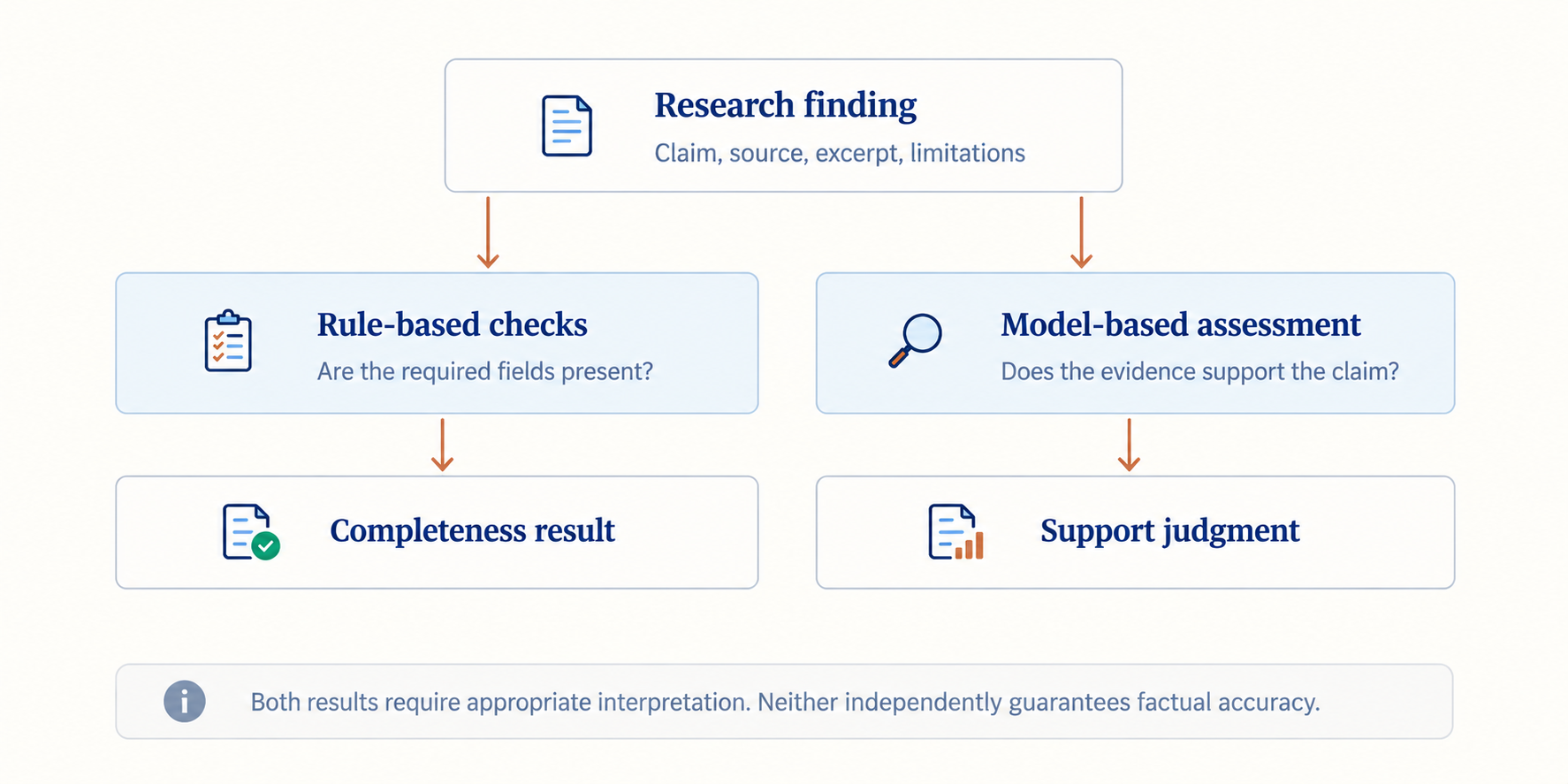
Some checks are straightforward. Python can verify that a source reference, excerpt, or limitations field is present.
But field presence is not evidence quality. A fabricated excerpt could pass a completeness check, and a valid JSON record could contain an unsupported claim.
Deterministic Checks vs. Model-Based Evaluation
There are two useful approaches to evaluating research outputs.
Deterministic evaluation uses explicit rules. For example, check whether a source URL exists, a required field is populated, or a reviewer label is recorded. The same input produces the same result under the same rules.
LLM-as-a-Judge uses a model to assess outputs against defined criteria, often called a rubric. Given a claim and the relevant source material, an evaluator model might assess whether the conclusion is adequately supported.
Model-based evaluation can help with judgments that are difficult to express as simple rules, but it has limitations:
- Evaluator models can make mistakes or favor certain wording.
- Results may vary between runs.
- The evaluator needs access to the relevant evidence, not merely a source URL.
- Model calls add cost and latency.
A useful approach is to establish a small set of human-reviewed examples and compare the model’s judgments against them.
Neither approach replaces source verification or human judgment when the consequences of an incorrect conclusion are significant.
Hands-On Lab: Experiment 7.3
Run:
python3 lab7_3_research_quality.pyThe experiment examines three fictional findings:
- Documented and qualified: Required fields are present, and a mock reviewer labels the claim supported.
- Missing evidence: The finding lacks an excerpt, limitations, and a completed support review.
- Unsupported conclusion: All fields are present, but a mock reviewer labels the conclusion unsupported.
Observe: Why does Case 3 pass every field-presence check but still receive a warning?
Try it: Change the recorded support label for Case 3 and rerun the script. Notice how the result changes even though the program has not examined any source material.
The reviewer labels are predefined; the script performs no model-based evaluation.
From Quality Checks to Repeatable Evaluation
A single evaluation helps us inspect one result. To understand whether an agent system behaves consistently, we need to test multiple cases against defined expectations.
In Lesson 7.4, we’ll turn these checks into repeatable tests that can detect changes and regressions.
Test Your Understanding
Question 1 of 3
A research record passes Pydantic validation and contains a source URL, excerpt, and limitations. What can we conclude?