It Works. Is It Ready?
By the end of Module 9, our research application could investigate a question, write a validated brief, obtain an independent publication recommendation, and publish only after approval under an authorized reviewer ID.
That is a real achievement. But a successful run on your computer answers a narrower question than it seems: can this design work? It does not yet answer: can people depend on it?
Building on Module 9
In Module 9, we built a research application with separate agent roles, governed tool access, evidence validation, human approval, and audit records.
These capabilities provide a foundation for production, but they were implemented and tested in a controlled local environment. Moving beyond that environment introduces additional requirements for reliability, security, shared access, and ongoing operation.
What a Successful Run Proves
A successful lab run shows that the design works once, under supervision. In our case:
- One person starts the run from a terminal and watches it.
- One computer stores every record as local files.
- One session runs at a time.
- A human is present to read error messages and decide what to do next.
During development, the complete live workflow was run end to end once. The first attempt stopped partway through with an Event loop is closed error, after the research had already succeeded. The error came from how the application ran the two agents, not from either agent’s decisions. Application and runtime failures can occur even when an agent’s reasoning succeeds. That failure is why Lab 9 can resume a review without repeating the research.
In a lab, someone notices the failure and runs a recovery command. In production, the system must detect it, preserve the completed work, and recover, often with no one watching.
Lab 9’s own documentation also notes that its budgets are provisional, and that one run does not establish how the agents typically behave.
Behavior Versus Infrastructure
It helps to separate two layers:
| Layer | What it covers | In our application |
|---|---|---|
| Agent behavior | What the agents decide and produce | Search choices, evidence judgments, the brief, the publication recommendation |
| Infrastructure | What keeps that behavior running, protected, and observable | Where the code runs, where files are stored, who can sign in, how failures are handled |
Production readiness requires both. A well-behaved agent on unreliable infrastructure loses work or exposes data. Reliable infrastructure cannot make a poorly behaved agent useful.
The layers are not fully independent. A different model version, new data sources, or real user requests can change how the agents behave, so moving to production can affect the application as well as its infrastructure.
Modules 7 and 9 focused mainly on behavior and the controls around it. This module focuses on what production adds.
From Lab to Service
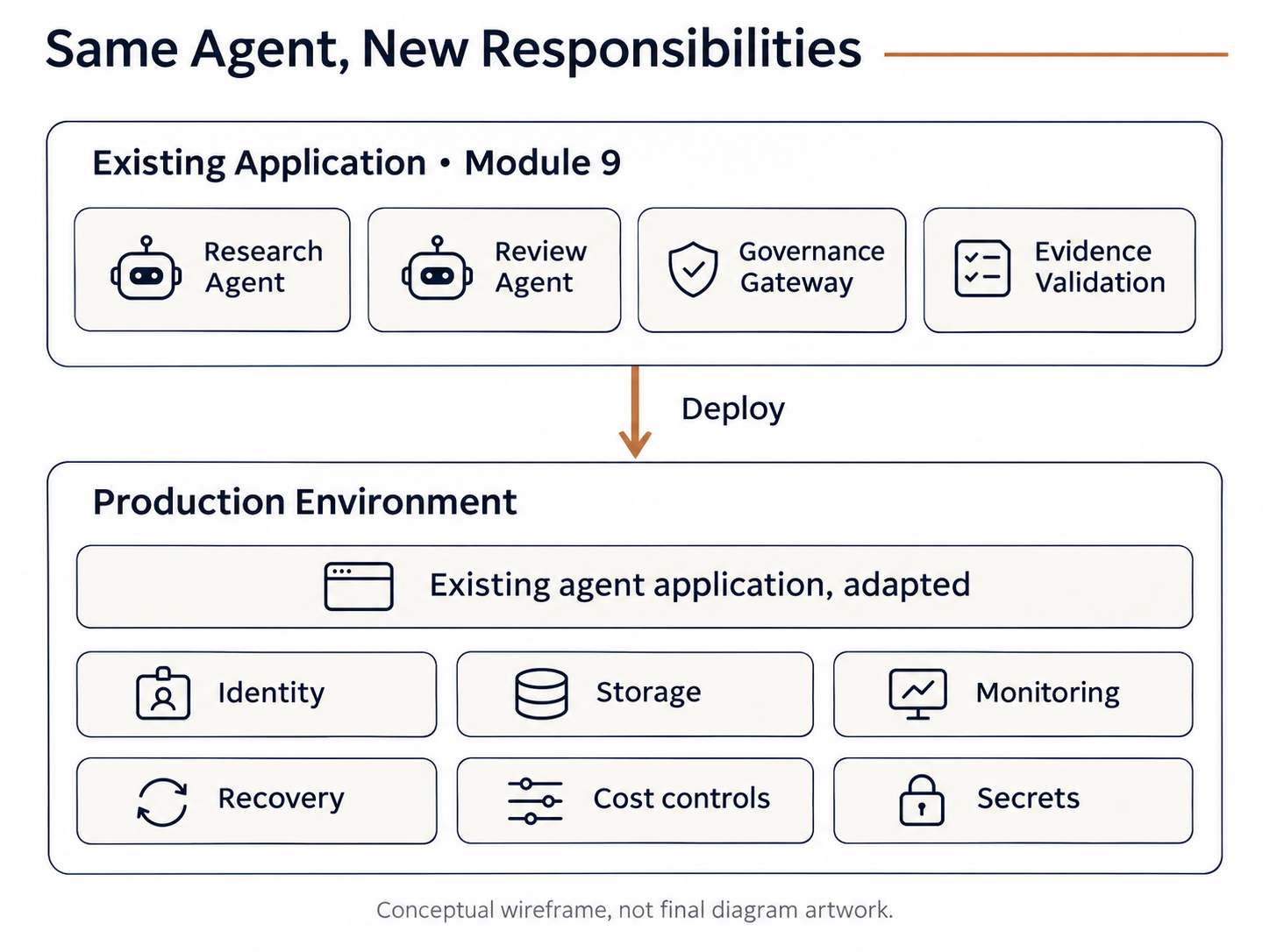
Lab 9’s capabilities fall into three groups: those it demonstrated, those it implements with limits appropriate to a local lab, and those it does not implement at all.
Demonstrated in Module 9
Lab 9’s governance design works as intended, but it may need adaptation and further testing with real users, data, and volumes. Its retrieval safeguards are application-level checks that complement, rather than replace, production network and security controls.
Implemented, With Local Lab Limitations
These capabilities exist in Lab 9, but in a form suited to one learner on one computer. Each one is a starting point, not a production equivalent.
| Capability | What Lab 9 does | What it is not |
|---|---|---|
| Operating budgets | Limits requests per session | Not production spending control |
| Audit trail | Records decisions and outcomes | Not tamper-evident |
| Reviewer identification | Accepts policy-defined reviewer IDs | Not authenticated identity |
| Publication | Writes approved reports locally | Not a publication service |
| Recovery | Supports manual resumption | Not automated recovery |
| Records | Stores sessions as local files | Not durable shared storage |
| Credentials | Reads local API keys | Not managed secrets |
Not Yet Implemented
Other capabilities do not exist in the lab and would need to be built, or provided by a framework or platform:
- A service runtime. Today, a person starts each run from a terminal and confirms live calls. A deployed service would accept requests from an application, an API, or a schedule, and run workflows in the background. This is an architectural consideration rather than a measured finding: a research run can involve many model turns, searches, and page retrievals, so a production design should not assume it finishes within a single web request.
- Identity and access management for users, reviewers, and administrators.
- Protected audit storage that detects or prevents changes.
- Monitoring and alerting across all runs, covering errors, latency, cost, and quality, building on the observability practices from Module 7.
- Cost controls that apply across sessions, users, and time periods, with alerts before limits are reached.
- Network controls beyond the application’s own checks. Lab 9’s destination rules are application-level checks, not a network firewall.
- Change management for model versions, prompts, and policies, so that updates are evaluated before release.
Most of these items concern the environment around the agents rather than the agents themselves. That does not mean the application stays the same. Production may require policy changes, such as new reviewer roles, different budgets, or additional allowed destinations, and the agents’ behavior must be tested again under real conditions.
Attention, Product Managers
Waiting Is Part of the Workflow
In the lab, approval happens when you run the review command. In a real organization, a publication request might wait hours or days for a reviewer.
The system must keep the pending request safe, notify the right person, and confirm the content has not changed when they finally approve. Lab 9 already stores pending requests and checks the content again at approval. A deployed service would also need notifications, reminders, and a clear owner for requests that are never reviewed.
What Carries Forward
Beyond the governance controls above, several design decisions describe what the application should do, not where it runs:
- Agent instructions and the research Skill, which define how the agents reason about evidence.
- Tool contracts, including typed arguments and source IDs issued by the application instead of URLs supplied by the agent.
- The audit event design, which separates policy decisions from execution outcomes.
- Offline mode and prepared fixtures, which can become regression tests for future changes.
These are a foundation, not a finished service. Each may need adjustment as the surrounding system changes.
Why This Shapes Our Next Decisions
Every limitation and missing capability above is a choice: build it with an SDK or framework, rely on a managed agent platform to provide it, or accept what a ready-made agent offers. Many organizations combine these approaches.
Those choices determine cost, speed, control, and who is accountable when something goes wrong. They are product decisions as much as technical ones.
Lab 10.1: Map a Session to Production Responsibilities
In this exercise, you’ll examine a Lab 9 session and decide what each record would require in a deployed service. No new code and no paid calls are required.
Use the extracted lab-09 folder from Module 9. If you no longer have it, download it again from Lesson 9.1.
Reuse a session from Module 9, or create a new offline session from the extracted lab-09 folder:
python -m lab9.runSelect option 1, the offline research workflow. At the end, the application prints your session ID and its folder.
Open the folder lab9/data/sessions/<session_id>/. It contains:
| File or folder | What it holds |
|---|---|
session.json |
Mode, budgets, models, and timing |
requests.jsonl |
Every request submitted to the Gateway |
audit.jsonl |
The Gateway’s decisions, review attempts, and outcomes |
research/ |
Issued sources, retrieved text, and every brief submission |
reports/ |
The accepted research package |
review_output.json |
The publication recommendation and the request’s current status |
approvals.json appears after a reviewer approves or rejects a request.
Choose three of these records. For each one, answer:
- Who should be able to read it, and who should be able to change it?
- What would happen if it were lost, or if two runs wrote to it at the same time?
- Is this part of the agent’s behavior, or the infrastructure that supports it?
Choose one production-readiness gap. Explain why it matters and what you would need to consider before selecting a solution.
What We Learned
Our Module 9 application already enforces permissions, budgets, validation, approval, and auditing within the application. These controls provide a foundation for production, though they may need adaptation and further testing.
A successful lab run proves the design can work. Production adds responsibilities that the lab handles manually or not at all: identity, durable and protected storage, concurrent use, monitoring, recovery, cost control, and secrets management.
In Lesson 10.2, we’ll compare where an agent can run and the operational tradeoffs of each deployment architecture.
Test Your Understanding
Question 1 of 3
What does a successful local agent run demonstrate?