
Module introduction
In previous modules, we developed and tested the building blocks of an AI research system: agents, tools, Skills, MCP, orchestration, and evaluation, primarily using prepared research data.
Now we bring them together in one research application that can work with real, current sources.
For the first time, you can have the Discovery Agent search the web for current information. Live research requires API access and may incur costs, so the application asks for permission before making API calls.
Offline and Live Mode
The labs run in Offline Mode by default. Offline Mode exercises the research application’s processing pipeline with prepared inputs: Python loads a prepared set of sources and applies fixed rules to their excerpts. No AI agent runs and no model call is made.
In Live Mode, two AI agents do the work that needs judgment. The Discovery Agent searches the web for research leads, and the Evidence Agent analyzes the content retrieved from each source. The application asks for your permission before making any live API calls.
Both modes produce the same kinds of records, which feed the same comparison and research brief stages in Labs 8.3 and 8.4. In both modes, the host application controls the execution sequence and validates every result, as in Module 6.
What We’ll Investigate
Our PM Role Trends Research Agent explores a question that is predefined in the lab’s research charter, lab8/config/research_charter.json. You don’t type it in:
Is AI Changing the Product Manager Role?
As AI becomes more capable in planning, design, and coding, we want to investigate:
- Are the boundaries between product management, design, and engineering becoming less distinct, more specialized, or both?
- Are expectations different in startups, growth-stage companies, and established organizations?
- Are employers looking for more strategic product managers, more hands-on builders, or people who combine both capabilities?
We’ll examine recent job postings and industry articles, including Product Builder roles and conventional PM positions.
The goal is to discover what the evidence suggests.
From Web Search to Research Brief
In Live Mode, we’ll search for current job postings and articles, examine their content, and extract evidence about role expectations. In either mode, we then compare findings across companies.
The final output is a source-linked research brief that identifies observed patterns, conflicting evidence, and unanswered questions.
A separate section will explore possible implications for the future of product development, clearly distinguished from the research findings.
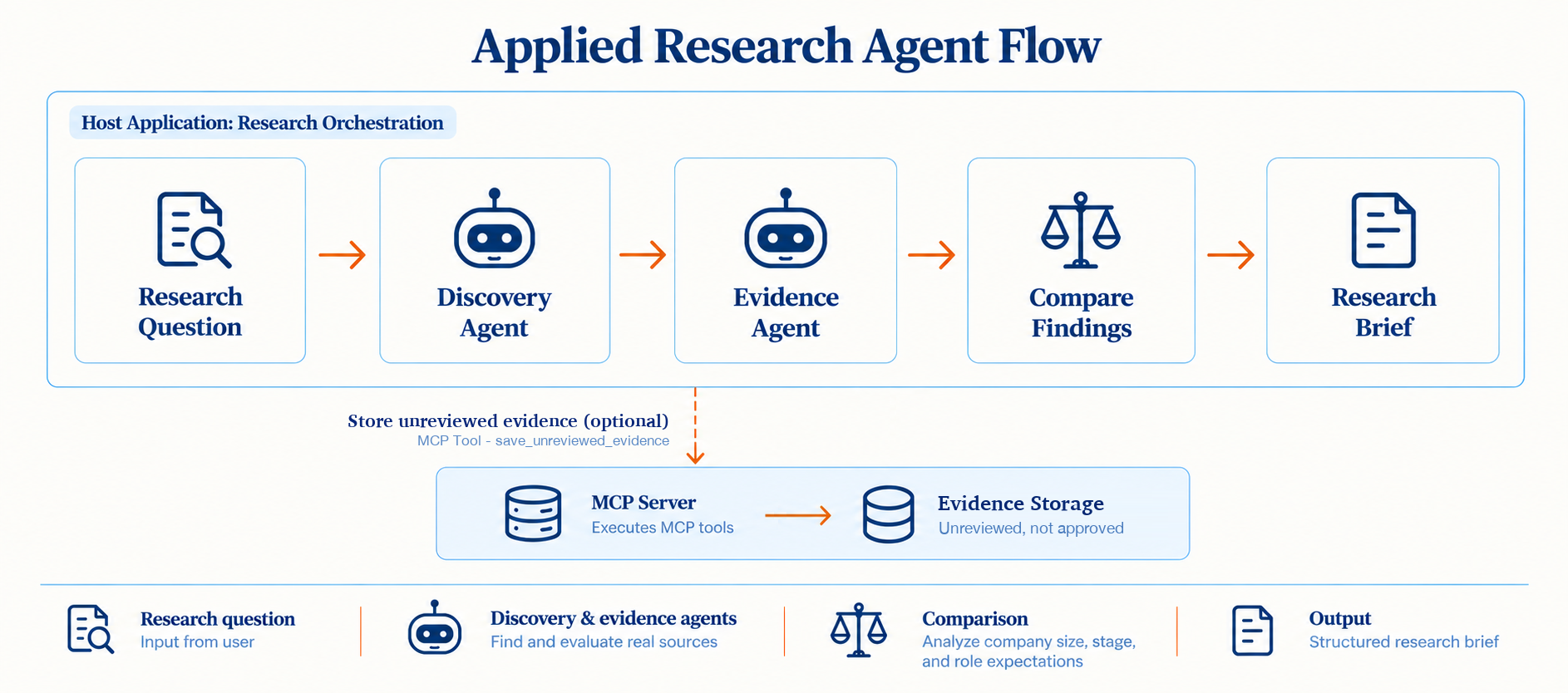
Architecture-to-Code Map
The flowchart shows how research moves through the system. The table below connects each architectural component to its implementation.
| Component | Implementation | Responsibility |
|---|---|---|
| Host orchestration | lab8/app/experiments.py |
Coordinates execution, validation, consent, and outputs |
| Mode selection | lab8/app/mode_selection.py |
Selects offline/live mode and loads credentials |
| Discovery Agent | lab8/app/live_discovery.py |
Runs live discovery using the Agents SDK |
| Web search | OpenAI hosted WebSearchTool |
Performs external searches in live mode only |
| Source screening | lab8/app/tools.py |
Processes candidates, dates, duplicates, and role relevance |
| Evidence Agent | lab8/app/agents.py |
Defines the Evidence Agent and its structured output (Live Mode only) |
| Evidence orchestration | lab8/app/orchestration.py |
Runs the Evidence Agent in Live Mode for Lab 8.2 |
| Offline evidence rules | lab8/app/evidence.py |
Rule-based classifier used in Offline Mode; validation for both modes |
| Research Skill | skills/research-evidence/SKILL.md |
Guides evidence evaluation |
| MCP persistence | save_unreviewed_evidence |
Stores unreviewed evidence when MCP is enabled in Lab 8.2 |
| Research outputs | lab8/data/runs/ |
Stores run records and generated results |