In Lesson 5.2, we saved research records through MCP, with a human approval step controlling what entered our knowledge store.
But we used a prepared, synthetic record to demonstrate persistence.
Now we’ll bring our Research Agent back and give it a more meaningful task: discover actual research, evaluate the evidence, and propose a finding for approval.
Bringing the Workflow Together
Our Research Agent now has the components needed for a complete research workflow:
- Web search to discover external research sources.
- Research Evidence Skill to guide how sources are evaluated.
- Structured records to organize findings and limitations.
- Human approval to decide what may be retained.
- MCP persistence to save approved findings.
The important change is that the agent will generate a proposed finding based on discovered sources, rather than receiving one predefined in Python.
Discovering Real Sources
We’ll use the OpenAI Agents SDK’s hosted web search tool.
from agents import Agent, Runner, WebSearchTool

agent = Agent(
    name="Product Builder Researcher",
    instructions=research_instructions,
    tools=[WebSearchTool()],
    output_type=ProposedFinding,
)
The agent will search for evidence relevant to our continuing Product Builder hypothesis: whether AI-assisted product builders can reduce product-development handoffs.
The research results are not predetermined. They depend on the sources found during the run.
Applying Our Research Evidence Skill
We’ll reuse the Skill from Module 4.
SKILL = (
    Path(__file__).resolve().parent
    / "skills"
    / "research-evidence"
    / "SKILL.md"
).read_text(encoding="utf-8")
The lab includes these instructions in the agent’s initial configuration.
They guide the agent to distinguish supported claims from interpretations, identify uncertainty, and avoid presenting incomplete evidence as verified research.
Unlike our earlier selective-loading experiment, we aren’t asking the agent whether to load this Skill. For this workflow, evidence evaluation is always relevant.
Producing a Structured Finding
Instead of returning only a narrative answer, our agent produces a structured proposal.
We use a Pydantic model to define its fields:
class ProposedFinding(BaseModel):
    title: str
    source_url: str
    finding: str
    evidence: str
    limitations: str
    retrieval_status: str
The agent populates these fields using the information it discovers.
Setting output_type=ProposedFinding tells the SDK to ask the model for exactly these fields and return its answer as a ProposedFinding object. If the answer does not match the expected structure, the run fails rather than returning a malformed result.
result = await Runner.run(
    agent,
    "Find and assess one real external source "
    "for the Product Builder research hypothesis."
)

proposal = result.final_output.model_dump()
validate_record(proposal)
The lab validates the proposed record before presenting it to the learner.
However, structural validation doesn’t establish that the source is genuine or that the interpretation is accurate. Those still require review.
Understanding the Evidence Boundary
Our lab uses live web search, but it does not necessarily retrieve the full text of each article.
For this exercise, the agent is instructed to label its evidence:
retrieval_status: search_snippet
This is an important limitation.
A search result can help identify a relevant source, but its excerpt may omit essential qualifications, methodology, or context.
The agent must not claim to have read a complete article simply because it found a search result.
The retrieval_status value is part of the agent’s proposal. Validation confirms that it’s an allowed label, not what the agent actually accessed, so check it during your review.
Even when a record is well structured, its evidence may remain incomplete.
From Discovery to Approved Findings
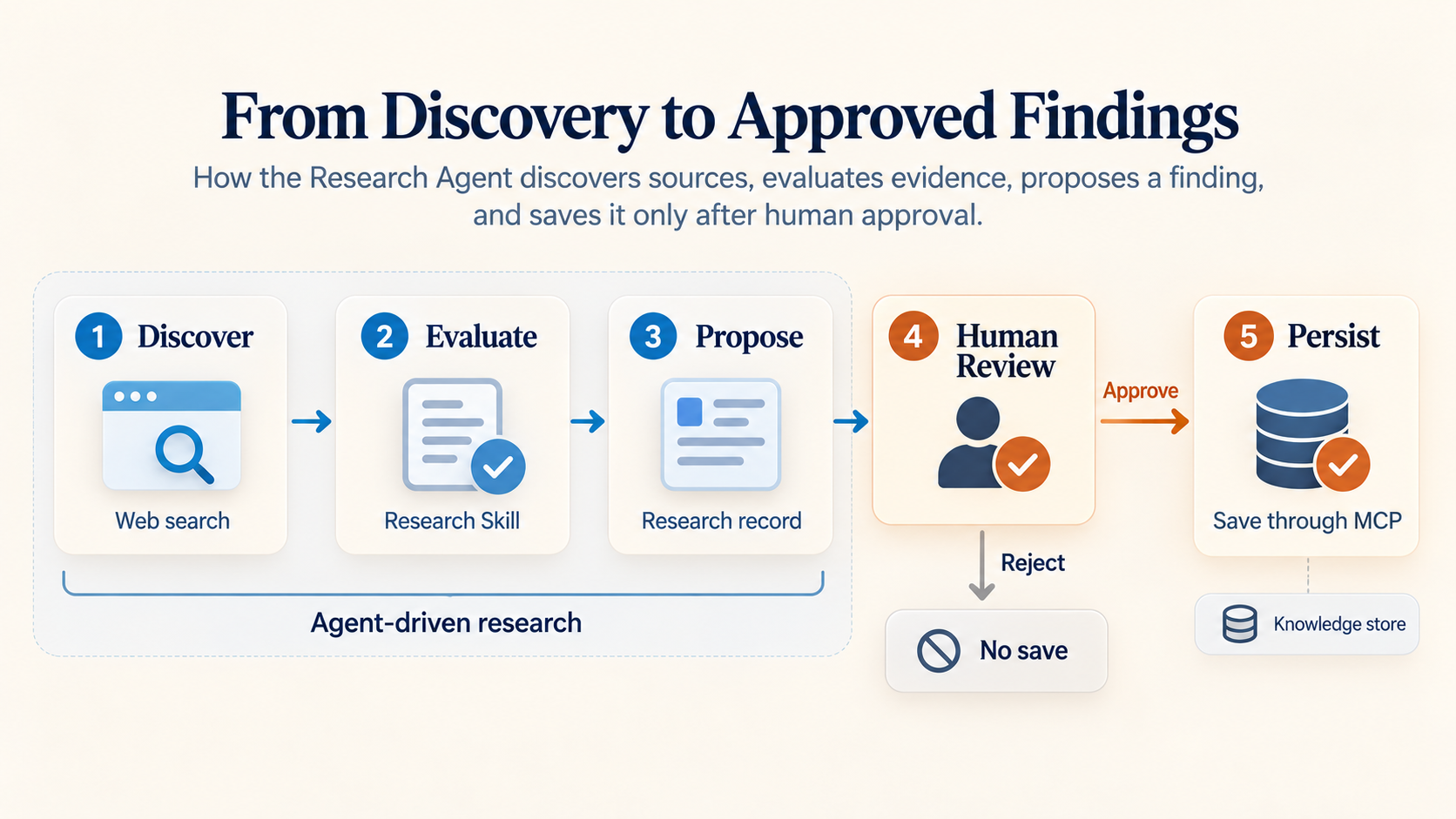
Our workflow follows five steps:
- Discover: Search for a relevant external source.
- Evaluate: Apply the Research Evidence Skill and prepare a cautious finding.
- Propose: Produce a structured record containing evidence and limitations.
- Approve: Present the record for human review.
- Persist: Save the approved record through MCP.
If the learner rejects the proposal, nothing is saved.
The approval decision happens outside the model. The agent cannot grant itself permission to write to the knowledge store.
Keeping Approval Outside the Agent
The Python application displays the proposal and asks the learner to review it.
decision = input(
    "Type APPROVE to save this exact proposal: "
).strip()

if decision != "APPROVE":
    print("Rejected. No record saved.")
    return
Only after approval does the host application connect to the MCP server and call save_research_record().
The server checks an approval token before writing the record to the JSON knowledge store.
The model does not receive that token or access to the persistence tool during its research run.
This is a teaching example of separating agent decisions from application-controlled authorization. The token check is not a substitute for production identity and access controls.
Try It Yourself
Use the shared Module 5 lab. From the module-05-lab folder, with its virtual environment active, run:
python lab5_3_discover_review_approve.pyYou’ll need your configured OpenAI API key and internet access. Hosted web search may incur API charges.
When the run completes, examine the proposed finding:
- Is the source URL genuine and relevant?
- Does the evidence support the finding?
- Are the limitations and retrieval status accurate?
- Would you be comfortable saving this as a research record?
Review the source yourself before approving. If the evidence is insufficient, reject the proposal.
If you approve, the host saves the record through MCP.
You can then inspect research/data/research_records.json to confirm that the new record was persisted.
What Makes This an Agentic Workflow?
The agent isn’t simply formatting a prepared finding.
It uses an external search capability, interprets retrieved information, and produces a structured proposal guided by specialized instructions.
At the same time, it operates within a boundary established by the application: it can recommend a record, but it cannot authorize its persistence.
This combination of agent autonomy and controlled execution is an important foundation for enterprise AI systems.
Our implementation remains educational. A production research workflow would need stronger source verification, authorization, auditability, and storage controls.
What Did You Learn?
- An agent can combine discovery, evaluation instructions, and structured output in one workflow.
- Live search results must be distinguished from fully retrieved and verified source content.
- A research proposal is not automatically trusted knowledge.
- Human approval and MCP persistence can remain outside the agent’s direct control.
- An agentic workflow can provide useful autonomy without giving the model unrestricted authority.
With Module 5 complete, our Research Agent can discover sources, prepare structured findings, and save approved records for future use.
Test Your Understanding
Question 1 of 3
What is the main difference between the research workflows in Lessons 5.2 and 5.3?