What Should We Build Ourselves?
Our PM Role Trends Research Agent uses the OpenAI Agents SDK, but we built its governance gateway, evidence validation, approval rules, and session records ourselves.
As we move toward production, which of these responsibilities should we continue to own, and where could a framework or managed platform help?
Frameworks and Managed Platforms
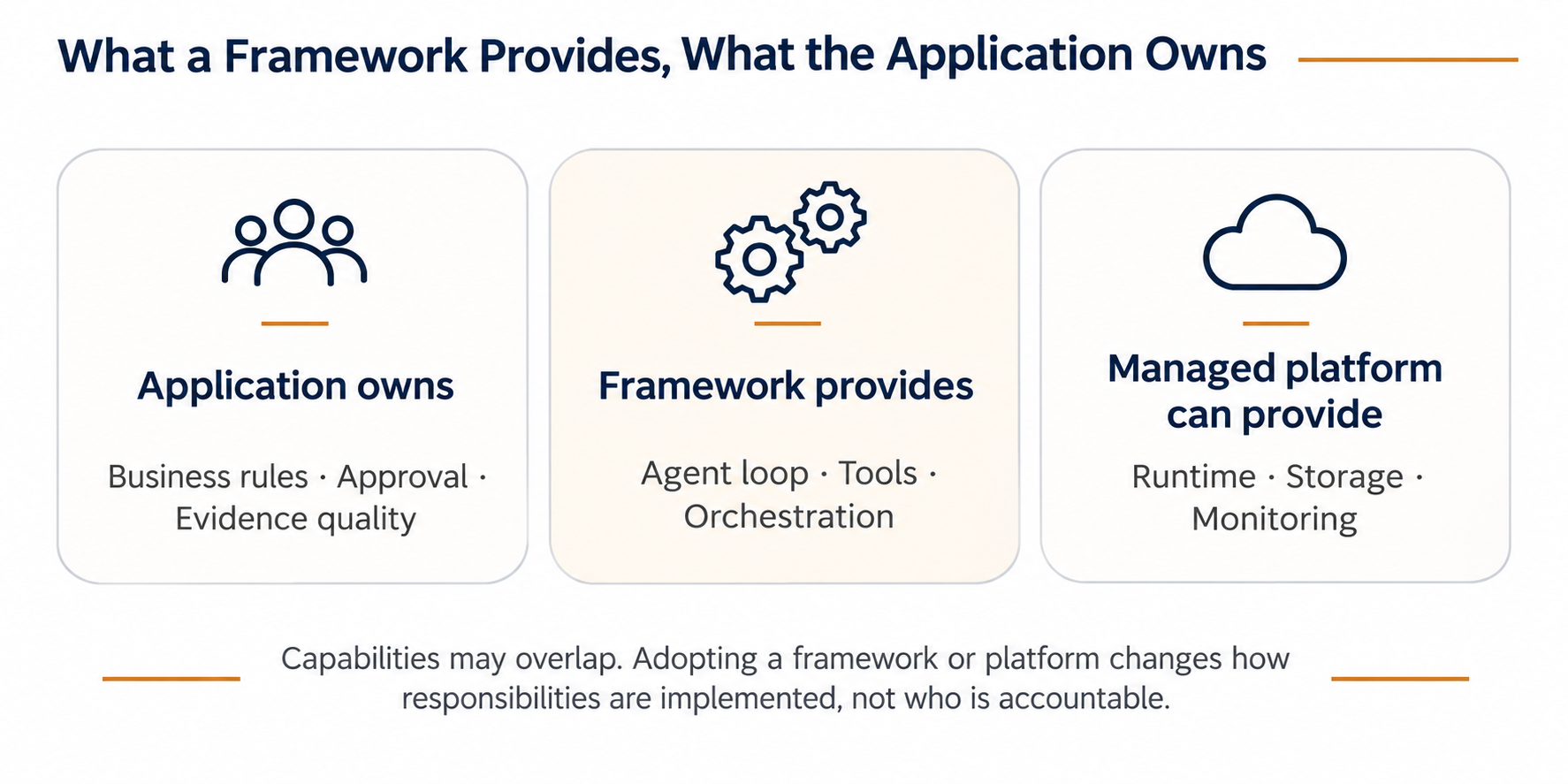
An agent SDK or framework provides reusable building blocks for developing agents, such as tool calling, coordination, workflow execution, state handling, and tracing. Available capabilities vary. A framework can reduce development work, but it does not automatically make an application secure, reliable, or ready for production.
A managed agent platform provides some of the services needed to run and operate agent applications. Frameworks and platforms can be used together.
| Agent SDK or framework | Managed agent platform | |
|---|---|---|
| Main role | Helps developers build and coordinate agents | Provides services to run and operate agent applications |
| May provide | Tools, workflows, state support, tracing | Hosted execution, storage, monitoring, scaling |
| Main advantage | Implementation flexibility and control | Less infrastructure to assemble and operate |
| Tradeoffs | More engineering and operational work | Platform constraints, costs, provider dependencies |
Neither option removes the need for application-specific decisions about business rules, permissions, quality, and oversight.
Examples
We used the OpenAI Agents SDK in our labs. Other approaches include LangGraph, which emphasizes explicit workflows and stateful execution, Microsoft Agent Framework, and Google’s Agent Development Kit (ADK). Their design choices and tradeoffs deserve closer attention, so we’ll reserve detailed comparisons for an optional appendix rather than turning this lesson into a vendor survey.
What Remains Our Responsibility?
Consider three requirements from our research agent:
| Requirement | Framework or platform may support | Our application must still define |
|---|---|---|
| Publication review | Workflow pauses and approval steps | Who may approve, what needs approval, and how authority is verified |
| Recovery | Checkpoints and persistent state | What to preserve, what can be retried, and how to avoid duplicate actions |
| Governance and audit | Tool controls, tracing, and logs | Business policy, trusted identity, record protection, and retention |
The distinction matters: having an approval feature is not the same as enforcing an organization’s approval policy. Likewise, recording traces does not necessarily provide the audit protections a business requires.
Frameworks also cannot define our standard of research quality. As we learned in Module 9, matching a quotation to retrieved text establishes consistency with that source, not the truth of the underlying claim.
Choosing Based on the Application
The starting point is what the application needs, not which framework offers the longest feature list.
For a simple agent, an SDK and a few supporting services may be sufficient. A workflow with several agents, interruptions, or human review may benefit from more explicit orchestration and state management. A managed platform may reduce operational work if it supports the necessary integrations and controls.
Before choosing, consider workflow complexity, required permissions, access to private systems, operating responsibilities, cost, and dependence on a provider. There is no automatic winner.
Attention, Product Managers
You don’t need to implement the framework yourself, but its selection affects delivery, integrations, costs, and product controls. Be clear about the requirements driving the choice and what the team will still need to build or operate.
Lab 10.3: Assess Build and Platform Responsibilities
Imagine that several researchers will use our Module 9 application and that publication review must survive an interrupted run.
Compare two approaches:
- Continue with an SDK or framework and add the necessary supporting services.
- Use a managed platform for selected runtime or state capabilities while retaining our governance and validation rules.
For each, identify one capability it could provide, one responsibility the team would retain, and one question to resolve before adoption. Which would you investigate first, and why?
There is no single correct choice. No new code or paid calls are required.
What We Learned
Frameworks help us build agent applications; managed platforms can help us operate them. We can combine both, but business rules, quality standards, permissions, and accountability still need explicit ownership.
In Lesson 10.4, we’ll examine ready-made agents, where more of the implementation is packaged into a product.
Test Your Understanding
Question 1 of 3
A team uses an agent framework that supports human approval steps. What does the application team still need to define?