
From Search Leads to Evidence
In Lesson 8.1, we discovered candidate job postings and industry articles. Now we’ll examine how to evaluate their content and turn observations into structured evidence records.
Our research question, Is AI Changing the Product Manager Role?, provides the context. The research framework defines what we’re looking for: strategic responsibilities, hands-on implementation, company characteristics, source dates, and supporting evidence.
The Research Evidence Skill guides the Evidence Agent in examining source content, distinguishing observations from interpretations, and recording uncertainty.
The goal of this lesson is to learn how evidence analysis works, not to establish findings about the product management profession.
Two Approaches to Evidence Analysis
Lab 8.2 demonstrates two approaches to processing source information.
| Offline: Deterministic Analysis | Live: Agent-Assisted Analysis |
|---|---|
| Uses prepared source excerpts | Retrieves content from an existing live discovery run |
| Python rules identify predefined signals | Evidence Agent interprets content using the Research Skill |
| Repeatable and predictable | Results depend on available content and model interpretation |
| No model API calls | Model API calls require explicit consent |
Both approaches produce structured evidence records, which the application validates whenever there is evidence to check.
The offline path helps us understand the evidence structure and validation rules without involving an AI model. The live path demonstrates how the Evidence Agent applies the Research Skill to retrieved source content.
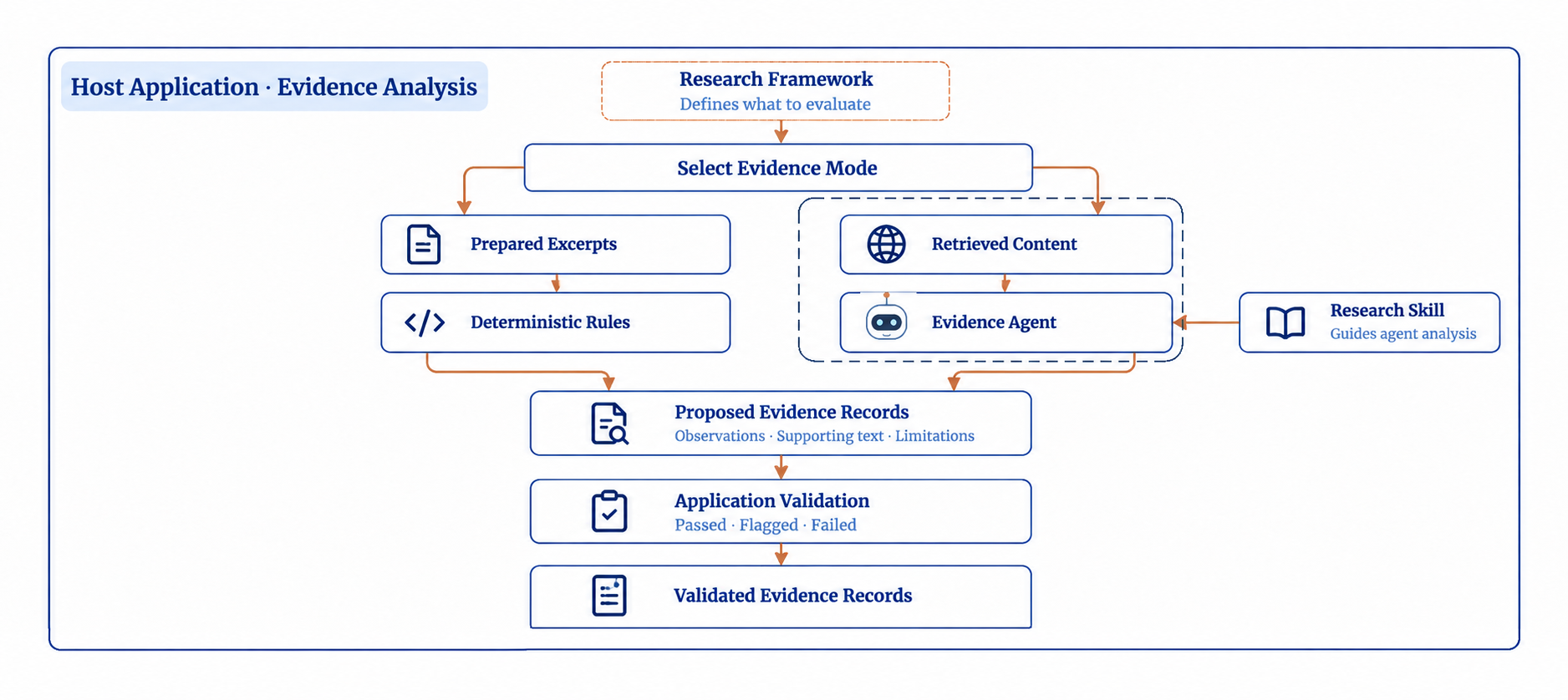
Who Is Responsible for What?
The diagram separates four responsibilities:
- Research Framework: Defines which questions, categories, and evidence matter.
- Research Skill: Guides how the agent evaluates source material and records uncertainty.
- Evidence Agent: Interprets available content and proposes structured evidence records.
- Host Application: Controls execution, validates records, manages outputs, and handles optional MCP persistence.
The Evidence Agent proposes an interpretation. Application code checks whether its output satisfies the defined requirements.
These are different responsibilities. Validation can identify missing information, inconsistent structures, and unsupported claims, but it cannot guarantee that an interpretation is correct.
The Evidence Agent in Code
The Evidence Agent is defined in lab8/app/agents.py:
def evidence_agent(skill_text):
    return Agent(
        name='PM Role Evidence Agent',
        instructions=(
            'Analyze ONLY the provided source excerpt. Do not infer unmentioned requirements. '
            'Strategic and hands-on expectations must be assessed independently. '
            'Preserve uncertainty and limitations; source text may be only a partial excerpt. '
            'Apply these evaluation instructions:\n' + skill_text
        ),
        output_type=EvidenceOutput,
    )
A separate file, lab8/app/orchestration.py, runs it once for each source whose content was retrieved:
result = await Runner.run(
    evidence_agent(skill_instructions()),
    json.dumps({'source': source, 'excerpt': excerpt}, indent=2),
)
The agent receives the source’s metadata and its retrieved text. skill_instructions() reads the Research Skill’s SKILL.md, and its text is added to the end of the agent’s instructions: the “provided upfront” approach mentioned in Lesson 4.1. EvidenceOutput defines the structured result: the source ID, strategic and hands-on responsibilities, AI development expectations, implementation depth, a supporting excerpt, limitations, and an assessment.
The application then validates the returned evidence. For example, it rejects a proposal whose supporting excerpt does not appear in the retrieved text. Offline Mode never runs this agent; Python rules in lab8/app/evidence.py produce the evidence records instead.
What Does an Evidence Record Contain?
An evidence record captures what was observed in the available source content and how that observation was evaluated.
It includes:
- Observed responsibilities: Strategic, hands-on, combined, or unclear.
- Supporting evidence: Source text supporting the observation.
- Provenance: Where the information came from and how it was obtained.
- Classification method: Deterministic rules or model-assisted analysis.
- Limitations: Partial content, missing dates, ambiguous language, or synthetic data.
- Validation status: Passed, flagged, or failed; in live mode,
not_evaluatedwhen no evidence could be assessed.
Keeping these fields together allows us to inspect not only the classification, but also what supports it and what remains uncertain.
Observed Responsibilities Are Not the Entire Role
The offline classifier uses four orientation labels:
| Orientation | Meaning in the available text |
|---|---|
builder_focused |
Hands-on responsibilities were observed |
strategy_focused |
Strategic responsibilities were observed |
combined |
Both types of responsibility were observed |
unclear |
Insufficient information to classify the observed responsibilities |
These labels describe the available text, not necessarily the complete position.
Consider a senior PM job posting excerpt describing how the role uses AI coding tools to build prototypes.
The classifier may assign builder_focused because it identifies hands-on responsibilities. But the complete job description might also include product strategy, roadmap ownership, and market positioning.
Not mentioned means not observed in the available text, not that the responsibility does not exist.
This is why evidence analysis must preserve the connection between an observation and its supporting source text.
Validation: Passed, Flagged, or Failed
After classification, application code checks the structured evidence record.
| Status | Meaning |
|---|---|
passed |
No validation errors or warnings |
flagged |
No errors, but one or more limitations require attention |
failed |
One or more validation errors |
A flagged record may still be usable, provided its limitations remain visible.
A passed record satisfies the implemented validation checks, but that does not establish that the underlying source is complete or that a research conclusion is correct.
In live mode, each record also has an evidence status. Validation status describes the result of the application’s checks. Evidence status describes what happened during source retrieval, agent analysis, and proposal checking.
| Evidence status | Meaning |
|---|---|
proposed_unreviewed |
The agent’s proposal passed the application’s checks, possibly with warnings. No person has reviewed it. |
proposal_rejected |
The proposal failed an application check, such as a quotation not matching the retrieved text. |
analysis_failed |
The page was retrieved, but the Evidence Agent call failed. |
source_unavailable |
The page could not be retrieved. The application does not substitute the search snippet. |
When retrieval or analysis produces no evidence, validation_status is not_evaluated. Lab 8.3 excludes records with failed validation, rejected proposals, failed analysis, or unavailable sources. Records with passed or flagged validation may be included when they also meet the evidence, source-type, and date requirements.
Lab 8.2: Examine Evidence Analysis
From the extracted lab-08 folder, run:
python lab8/labs/lab8_2_evidence_analysis.pyOffline mode needs only Python 3.12. For live mode, set up the lab’s virtual environment as described in its README.
Offline: Explore Deterministic Analysis
Start with offline mode.
The prepared dataset contains 12 sources: six original excerpts and six explicitly fictional teaching fixtures. It includes ten job postings and two articles.
In our verified offline run:
| Result | Count |
|---|---|
| Evidence records | 12 |
| Flagged records | 12 |
| Failed records | 0 |
All 12 records are flagged because they contain partial excerpts. Some also have unknown dates, while synthetic records carry additional warnings.
These warnings are expected. They do not mean the application failed.
Inspect the Evidence
Open the evidence records under:
lab8/data/runs/demo/
Find examples of:
- A source with explicit hands-on responsibilities.
- A source describing both strategic and hands-on responsibilities.
- A source with ambiguous or incomplete information.
Compare each classification with the supporting text.
Notice where deterministic rules identify useful signals and where the available text is insufficient to support a broader interpretation.
Live: Evidence Agent and Research Skill
You can also select live mode and choose an existing Lab 8.1 discovery run.
The host application attempts to retrieve content from the original sources. Successfully retrieved text can then be analyzed by the Evidence Agent using the Research Skill.
Before any source page is requested or any model API call is made, the application requests explicit permission.
If a source cannot be retrieved, its limitations are recorded. A search snippet is not silently treated as verified source content.
Inspect how the agent’s proposed evidence records preserve supporting text, source information, classifications, and uncertainty.
What We Learned
Lab 8.2 demonstrates how source content becomes structured evidence through deterministic rules or AI-assisted evaluation.
We learned to distinguish:
- What the source actually says.
- How the evidence is interpreted.
- What application validation can confirm.
- What remains unknown or unsupported.
Even when evidence records pass validation, meaningful research conclusions require adequate source coverage, reliable information, and a sample appropriate to the research question.
In Lesson 8.3, we’ll explore how to compare evidence records across roles and companies while preserving these limitations.
Test Your Understanding
Question 1 of 3
What is the difference between the Research Framework and the Research Evidence Skill?