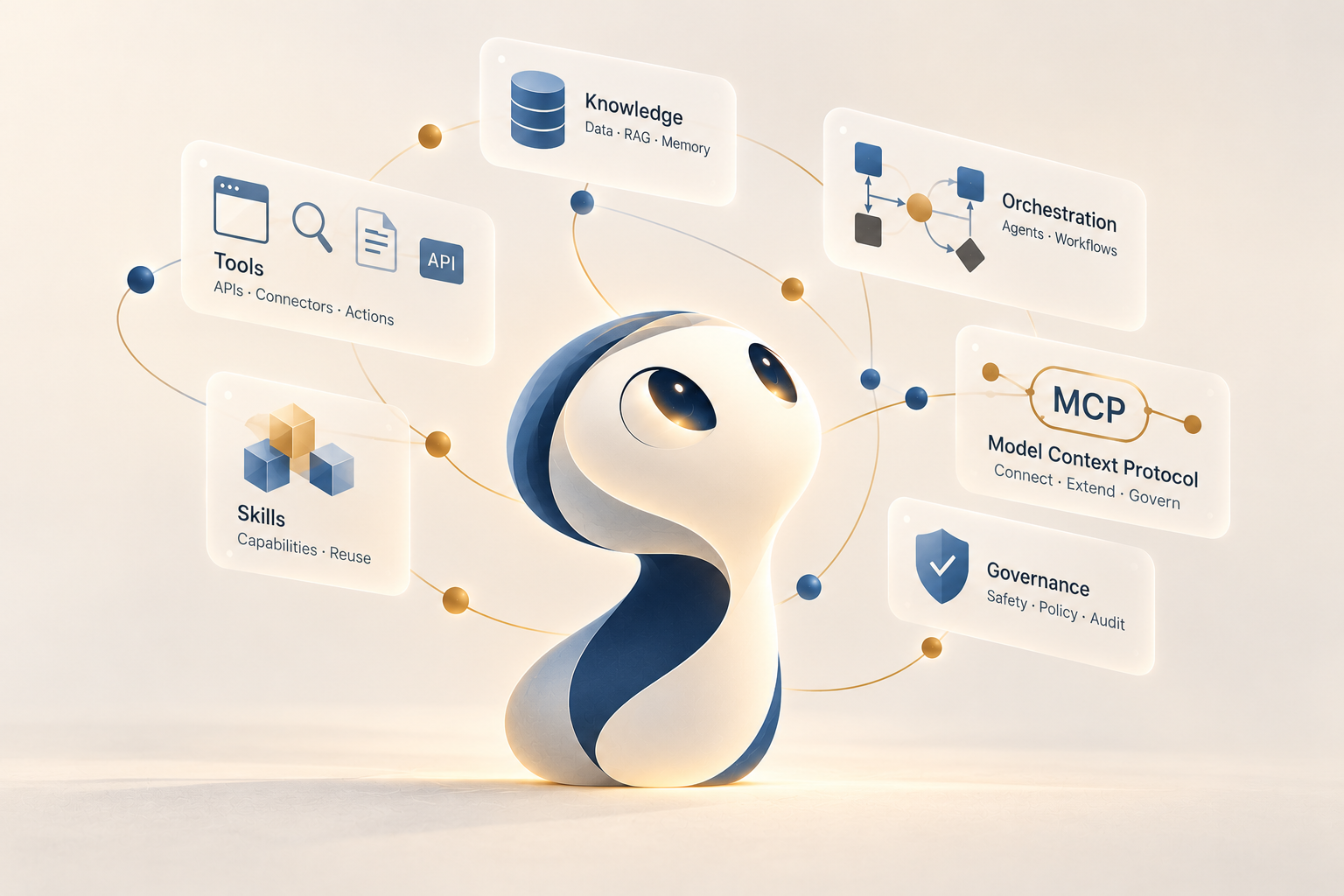
This course began with a question: what is really happening behind the friendly face of an AI agent?
For me, this was the “Hello, World!” of AI agents. I wanted to look under the hood and understand how these systems work.
We started with simple examples, adding capabilities as we explored what each one does and why we might need it.
Building a working agent was only part of the challenge. We also needed to evaluate its results, control its access to tools, handle failures, and determine when human review was necessary.
By the time we reached deployment, we could see just how much is hidden behind that friendly mascot face.
We can now look at products like Muse, Dots, or Grok Bot with a better understanding of the technologies and architectural choices that may be involved, without assuming we know how those particular products were built.
We also have a better sense of the questions to ask when evaluating an agent, whether we’re building one ourselves or considering an existing product.
Continuing Our Research Agent
Our PM Role Trends Research Agent is still a work in progress.
We’ve built the foundation, but there’s more to do. The next step would be to complete the research workflow, evaluate the agent’s performance, and make improvements based on what we learn.
The Capstone would build on that work, using the research agent to investigate how AI is changing the role of product managers. The findings would depend on the evidence collected, not on a predetermined conclusion.
What’s Next: Multi-Agent Systems
We’ve already experimented with multiple agents in this course. There’s much more to explore.
We’ve already experimented with multiple agents at a relatively small scale.
What happens in more complex multi-agent systems? How should responsibilities be divided among agents? How should they communicate and coordinate their work? What changes as the number of agents grows?
These questions lead naturally into a deeper exploration of multi-agent architecture and orchestration.
Our next question is:
How do we design and orchestrate systems in which multiple agents work together effectively?