The answer is not the whole execution
In Lesson 2.4, we equipped the Product Strategy Research Agent with live web search and asked it to investigate evidence about AI coding productivity.
The agent produced a readable answer. But a fluent response is only the final stage of a larger process.
To evaluate the research, we need to distinguish what the model requested, what the tools returned, and what the model concluded from those results.
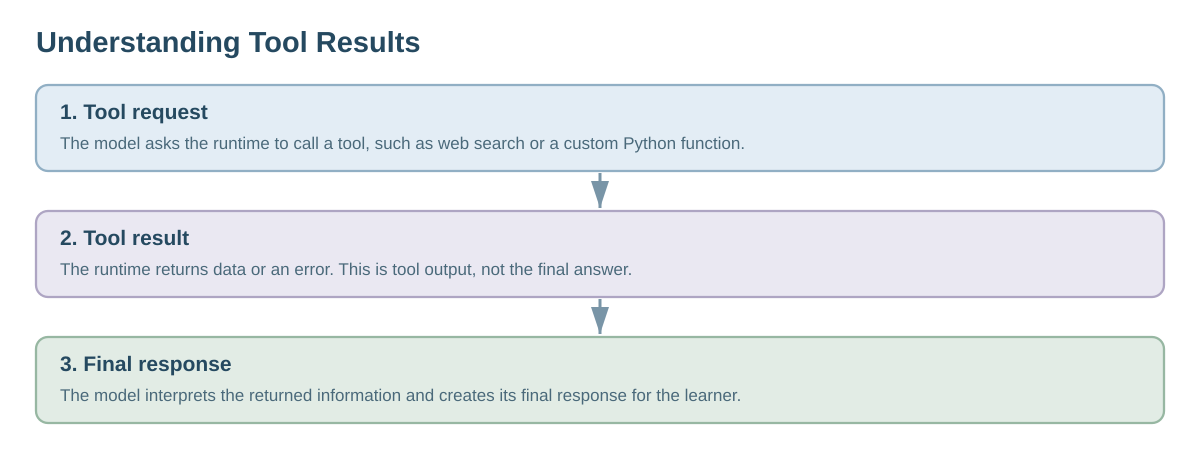
1. Three different things to examine
Tool request: A model-produced request to use a tool. For a custom function, this can include an explicit function name and arguments.
Tool result: Information or an error returned after execution. It provides input to the model’s next decision.
Final response: The model’s explanation after it processes the returned material. This may combine source facts, interpretations, caveats, and further inferences.
A final response is not a verbatim copy of tool output. Nor is a tool result automatically verified evidence.
2. What execution records can show
The OpenAI Agents SDK exposes run items, which may include entries such as:
ToolCallItem: the model requested a tool.ToolCallOutputItem: a tool output item, when surfaced in this form.MessageOutputItem: an assistant message.
In an earlier Lab 2.2 run, the output showed four ToolCallItem entries followed by a MessageOutputItem.
The observation is useful, but it tells us only part of the story. The recorded run did not include each underlying search query, individual search result, or a complete hosted-tool trace. Counts alone cannot tell us exactly which sources were read or how each call affected the final response.
Depending on the tool type, SDK version, and available tracing, some execution details may be represented differently. Inspect the actual run rather than assuming all tools expose identical records.
3. Examine the METR findings carefully
The included agent-generated research report discusses two METR publications. The findings come from those studies, not from an experiment conducted by the agent.
July 2025: experienced open-source developers
METR reported an experiment with 16 experienced open-source developers completing 246 tasks. In that study setting, AI-allowed work took about 19% longer on average than work performed without AI.
That is a finding about the sampled developers, tasks, tools, and measurement approach. It is not evidence that every developer or every AI coding tool makes work slower.
Primary reference: METR’s July 2025 study.
February 2026: follow-up and experimental limitations
METR later discussed a larger follow-up and explained why selection effects and measurement difficulties made its results unreliable for estimating a definitive overall speedup.
The correct reading is not that the follow-up conclusively reversed the 2025 finding. It is that the methodology and observed participation patterns complicated interpretation.
Primary reference: METR’s February 2026 follow-up.
The accompanying findings file is an included agent-generated report requiring independent source verification. Consult the cited primary publications before relying on a specific statistic or methodological claim.
4. What this evidence does—and does not—tell us
Our broader Product Builder hypothesis is concerned with how a person with product, design, and engineering judgment might use AI coding tools to reduce handoffs and reach testable software more quickly.
The METR research examines developer productivity under defined conditions. It does not directly isolate or measure:
- End-to-end time from product concept to validated working experience.
- Waiting and coordination between product, design, engineering, and review.
- The quality of product decisions or customer learning.
- The ability of an AI-assisted Product Builder to produce usable software across disciplines.
That does not make the METR studies irrelevant. It means they answer a different, narrower question.
Evidence becomes more useful when we understand both what it supports and what it leaves unresolved.
5. Two questions that improve agent research
Try asking the web-search agent:
What specifically was measured in each METR study, and which features of the methodology limit how broadly we can apply the findings?
Then ask:
Which parts of our Product Builder hypothesis remain untested by these studies, and what measurements would provide stronger evidence?
Compare the two answers. The first investigates source methodology; the second evaluates fit between evidence and the hypothesis.
When evaluating the responses, look for a clear distinction between established findings, the agent’s interpretations, and evidence that is still missing.
6. Optional experiment
Run the Lab 2.2 script again with a question focused on research design rather than reported speedup:
Find credible empirical approaches to measuring elapsed time, handoffs, rework, and time-to-user-feedback in AI-assisted product development. Identify which measures would complement studies of coding-task completion time.
This is an optional paid web-search experiment, not a third required lab or downloadable package. It may produce different sources on different runs.
What did you learn?
A tool call doesn’t prove that an answer is correct, and the execution record may not show every step involved in producing it.
To assess an agent’s work, separate the request, the returned information, and the model’s interpretation. Evaluate cited sources and make sure their measurements actually address the question you are trying to answer.
Test Your Understanding
Question 1 of 3
An earlier Lab 2.2 run recorded four ToolCallItem entries followed by a MessageOutputItem. What can you conclude?