When a Capable Agent Isn’t Enough
In Module 8, we built a research application that discovers sources, evaluates evidence, and produces findings.
In Module 9, our Research Agent takes on greater responsibility. It chooses search strategies, retrieves information, evaluates evidence, and produces a research brief. A second agent independently reviews the brief and recommends whether it should be published.
But there’s an important question:
If an agent can decide what to do, should it also have the authority to do it?
Consider an enterprise research agent with access to company information and external tools. It might publish a report containing confidential information that was never intended for release.
Even a capable agent can make an unsafe decision. Enterprise governance establishes controls that do not depend on the agent always making the right choice.
Capability Is Not Authority
An agent’s capabilities describe what it can do. Its authority determines what it is permitted to do.
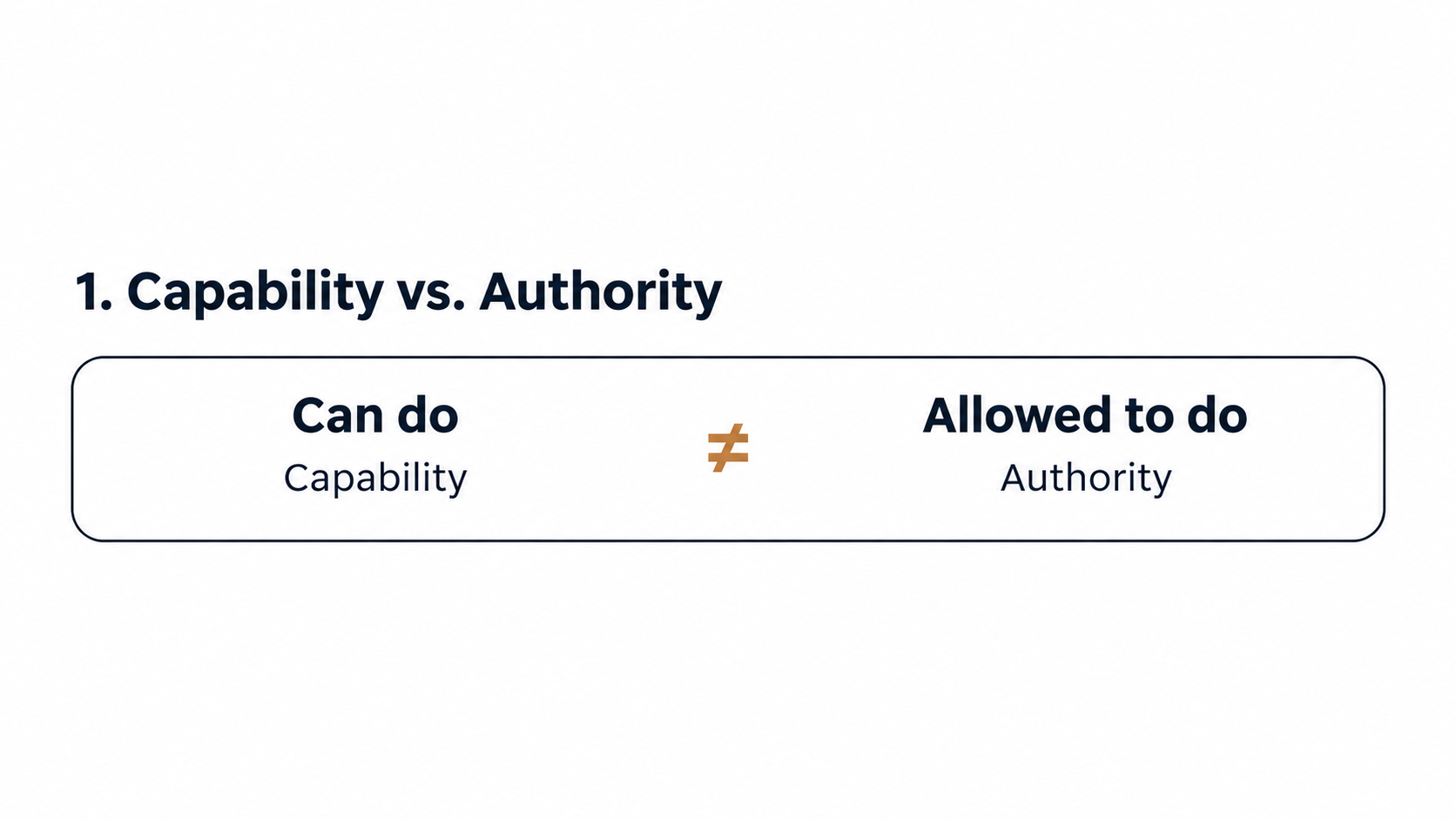
An agent may have the technical ability to call a tool without permission to do so. Prompts and Skills guide its behavior, but authorization must be enforced independently by the application or the services it uses.
How Governance Changes the Application
Imagine the Publication Review Agent recommends publishing a report containing confidential information.
The application converts that recommendation into an explicit action request. The Governance Gateway evaluates the request against its policies and determines whether to allow it, deny it, or require human approval.
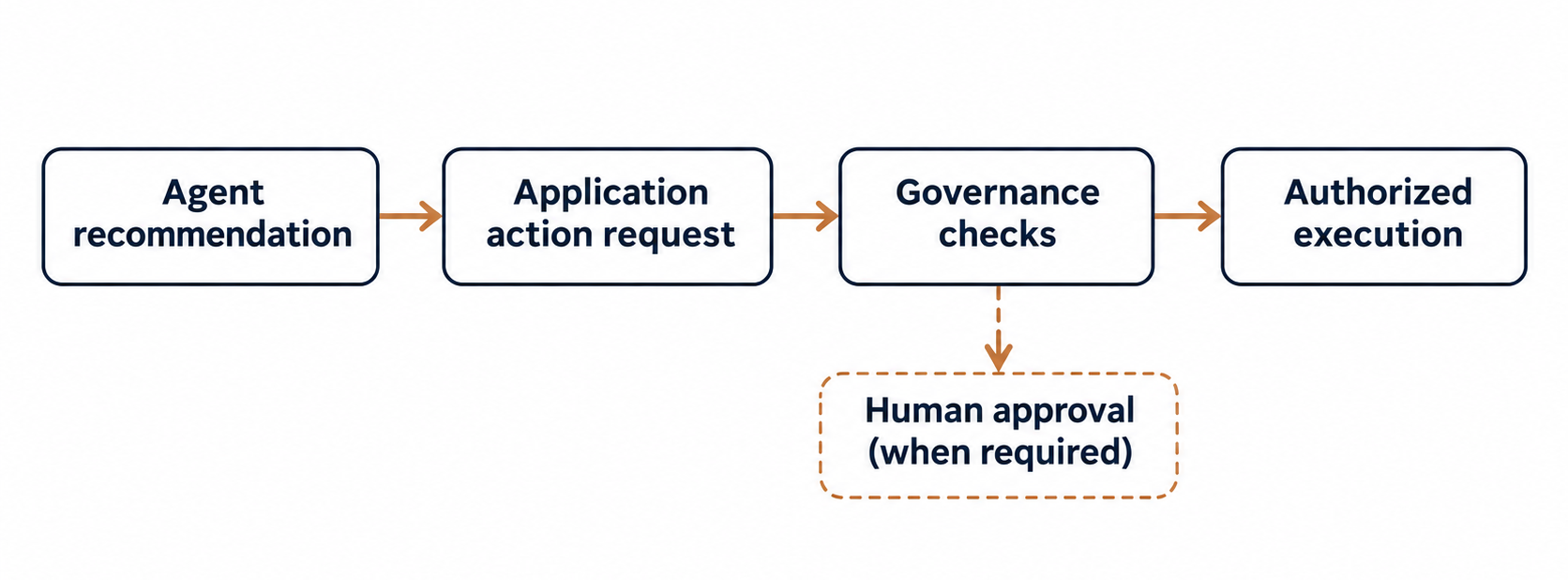
Governance does not guarantee that every problem with a report will be detected. It enforces the restrictions the application is designed to check. The goal is not to eliminate agent autonomy, but to define the boundaries within which agents operate.
The Cost of Greater Autonomy
Greater autonomy allows agents to process complex input, reason about it, and adapt their approach, but it can also introduce additional cost, latency, and variability.
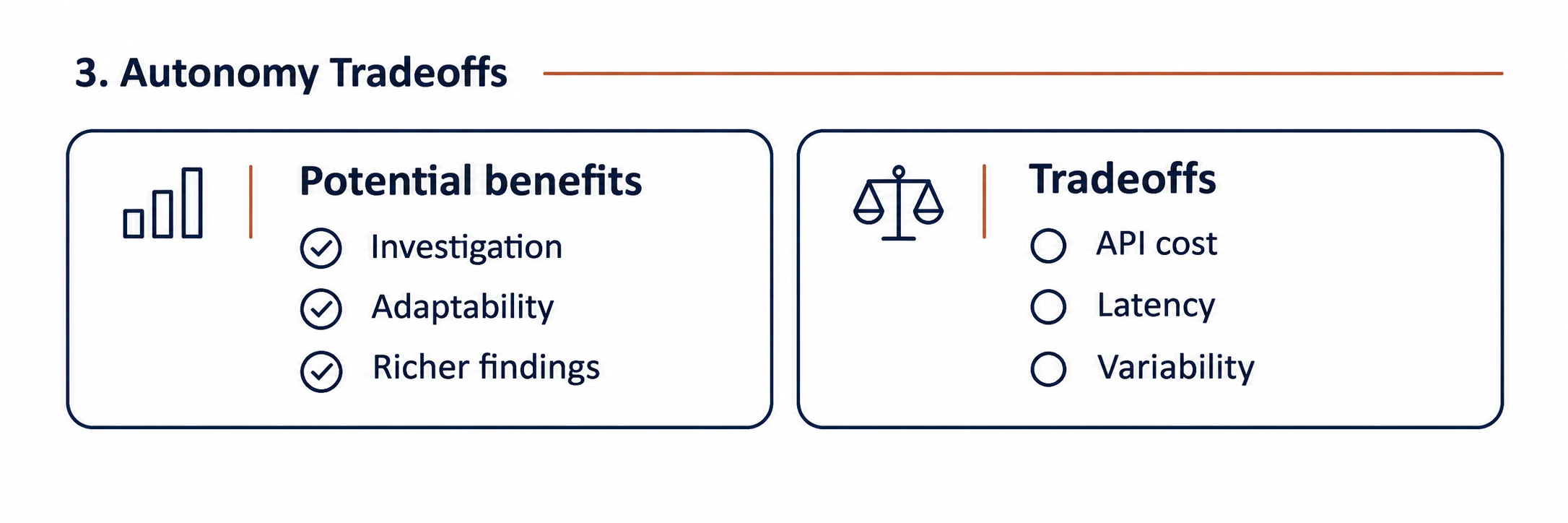
Operating budgets are therefore part of enterprise governance, alongside permissions and authorization.
Where Should We Use Agent Autonomy?
Not every operation benefits from autonomous reasoning.
| Autonomous | Deterministic |
|---|---|
| When decisions require weighing options, reasoning through uncertainty, and adapting to context. | When rules and expected behavior are clearly defined, with no ambiguity about how the decision should be made. |
| Example: Research Agent evaluating evidence and selecting sources. | Example: Governance Gateway enforcing permissions and operating limits. |
The objective is to use agent intelligence where reasoning adds value while keeping clearly defined controls predictable.
Lab 9.1: Observe Agent Judgment and Governance
In this first exercise, we’ll explore the existing Lab 9 application before examining its individual controls in later lessons.
Start with Offline Mode, which uses prepared research material and does not require an API key.
Extract the ZIP and open a terminal in the lab-09 folder. Offline mode needs only Python 3.12: no packages to install and no API key. You do not need Lab 8.
From the extracted lab-09 folder, run:
python -m lab9.runOn macOS or Linux, if python isn’t found, use python3 for the lab commands in this module.
Select the offline research workflow, option 1.
As the application runs, observe the distinction between research inputs, agent recommendations represented in prepared material, and governance decisions.
Consider three questions:
- What does the agent recommend?
- What does the application permit?
- What prevents a publication recommendation from executing automatically?
Offline Mode uses prepared material, so it does not reproduce live agent reasoning. Live Mode allows you to observe actual agent decisions and tool selection, with explicit consent and possible API costs. It requires the packages in the lab’s requirements.txt, installed in a virtual environment in the lab-09 folder as described in the README, and an OPENAI_API_KEY, set in your terminal or in a .env file in the lab-09 folder (copy .env.example).
You do not need to complete a live run for this lesson.
What We Learned
An agent can be capable without having unrestricted authority.
In our application, agents make research and publication judgments. The application enforces permissions, operating limits, and authorization requirements.
This separation allows agents to reason and adapt while keeping critical actions under enterprise control.
In Lesson 9.2, we’ll examine how the Governance Gateway enforces tool permissions, operating budgets, and access boundaries.
Test Your Understanding
Question 1 of 3
Why should an enterprise application enforce tool permissions outside the agent?